Ants in the compost bin: good, bad or a sign it's too dry?
Lots of ants in a compost bin usually mean the pile is too dry: moisten it and turn it. If they might be fire ants, read the fire-ant cautions first.
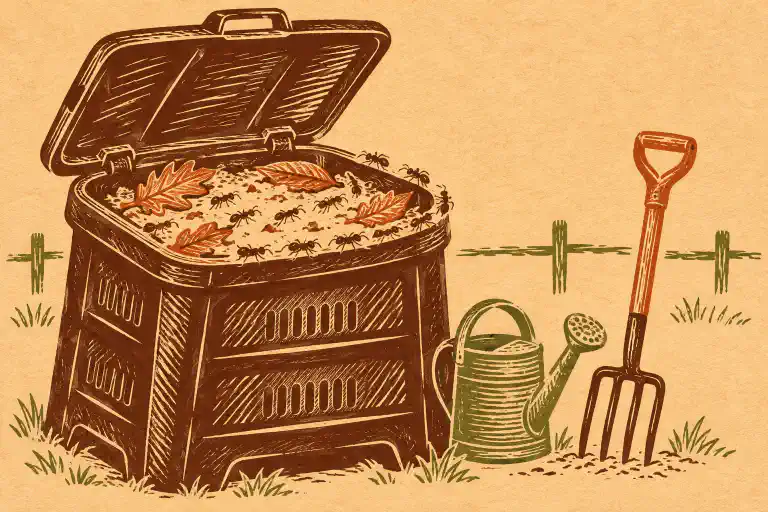
Lots of ants in a compost bin usually mean the pile is too dry, and often that it needs turning. University of Georgia (UGA) Extension and Santa Cruz County’s home composting program in California both link large numbers of ants to a dry pile, and an Extension Master Gardener answer on Ask Extension says such a pile likely needs turning more often. That’s easy to change, once you’ve checked they aren’t fire ants.
Quick fix
- Could they be fire ants? Check before you touch the pile. In the South, parts of California or Puerto Rico, small reddish-brown or black ants that swarm when disturbed may be fire ants. Read Fire ants in the compost pile before you put a hand or a fork in.
- Otherwise, squeeze a handful. If it crumbles, it’s too dry: rewet it in layers as you turn it (Compost too dry). Tumbler? Our tip: add water and spin it.
- Stir it with a fork to break up the nests, then leave it alone for a while so the ants can move out.
Why are there ants in my compost?
UGA’s composter tips explain it: “Ants like to use dry, undisturbed soil for their nests. If you’re seeing a lot of ants in your pile, it’s likely that the pile is too dry and that you’re not turning it enough.”
Are ants in compost good or bad?
The sources agree on what a lot of ants mean, but not on how much to worry. UGA’s composter tips file ants under “The bad guys”, among creatures that “almost always indicate a problem with the compost bin”. The Ask Extension answer is milder: “Some ants can be a sign of a healthy compost pile.” Santa Cruz County even sees an upside: ants “may actually benefit the composting process by bringing fungi and other organisms into their nests”, and their work “can make compost richer in phosphorus and potassium”.
Our reading: a few ordinary ants can stay; a crowd means water and turning. UGA would be stricter.
Is compost that had ants in it still fine to use? None of the sources we checked says whether compost that had ants in it is fine to use. Santa Cruz’s line on phosphorus and potassium is the closest.
How to get rid of ants in a compost bin
These steps are for ordinary ants. Possible fire ants? Read that section first.
- Check the moisture, then rewet in layers. Do the squeeze test from Compost too dry. Santa Cruz County says watering a dry pile from above often doesn’t work, “because dry materials shed water”. Pull the pile apart and restack it, watering each layer, until it’s what UGA’s composter tips call “as damp as a wrung-out sponge”. Mostly woody prunings? Santa Cruz says that pile “may need more fresh green materials” (browns and greens).
- Stir it to break up the nests. Santa Cruz’s advice is to “moisten and turn it or stir it with a pitchfork to disrupt their colonies”. A garden fork such as the Truper 4-tine spading forkad does the job. Our note, not the sources’: in a closed bin, work the water and the fork down through the lid; in a tumbler, add water and spin it.
- Then leave it alone for a while. “After stirring the pile, leave it alone for a time to give the ants a chance to leave,” Santa Cruz says.
- Keep it turned from now on. UGA’s composter tips say a pile “should be turned at least once a week”. Santa Cruz warns: “If there are many ants in your yard, they may return to the compost pile.”
Fire ants in the compost pile
USDA APHIS says imported fire ants “are found throughout the Southern United States and in parts of California and Puerto Rico”. They’re “1/8- to 1/4-inch long and reddish-brown or black in color”, and they “respond rapidly and aggressively when disturbed; hundreds of fire ants may swarm and run up vertical surfaces to sting.”
Keep clear first. Virginia Cooperative Extension’s tips for avoiding stings include “Avoid stepping on mounds” and “Leave the area as soon as fire ants are seen or if you are stung”, along with closed-toe shoes and socks.
Stings. UF/IFAS says the effects of a sting “can last up to 10 days and even become infected if broken open”, and that “some people have allergic reactions to fire ant stings, which can be severe.” Virginia Cooperative Extension warns that “People who are very sensitive to insect venom may experience wide-spread reactions after being stung by fire ants, including anaphylactic shock. People who are allergic to bee stings should seek immediate medical attention if they begin to experience breathing problems or other allergic reactions after being stung by fire ants.” Its tips add: “If stung, seek prompt medical attention if you experience whole body reactions such as hives, shortness of breath, swelling, and other symptoms of anaphylaxis,” and “If you are allergic to insect stings, carry an injectable epinephrine pen with you.”
Why they’re there. UGA’s fire-ant note says fire ants “often invade compost piles and vegetable gardens seeking food, warmth and moisture”, and “most often invade compost bins after someone abandons or neglects the composting process”. A pile “that is frequently turned won’t be attractive to these biting critters”, it says. Texas A&M AgriLife’s troubleshooting chart, from its Texas Community Watershed Partners program, lists the possible causes of a pile “infested with fire ants” as “Too dry, not hot enough, or food too close to surface”, and says to “Carefully rebuild pile to proper conditions, wetting thoroughly.”
Treatments, for fire ants only:
- Boiling water. If the ants “persist or become a nuisance, pour boiling water on the nest. Use extreme caution as this method can potentially be very dangerous to you and your garden plants. This rarely eradicates the colonies, but it may cause them to move to a new location.” (UGA’s fire-ant note)
- Bait near the pile, not in it. “As a last resort, use fire ant bait killer near — but not in — the compost pile or garden.” Insecticides applied to a compost pile, UGA’s note adds, “may kill other beneficial insects that are involved in the composting process. Avoid direct application of pesticides on the compost pile and follow the pesticide label’s instructions.” It goes on: “Use pesticides labeled for the location or site you want to treat. For example, do not use a product in a vegetable garden unless the product is labeled for use in vegetable gardens.”
- The Texas chart adds, for major infestations: “Broadcast low-toxicity fire ant bait”. It doesn’t say where; follow UGA’s near-not-in rule and the product label.
- For your own yard, APHIS says to “Contact your local extension specialist for guidance on what will work best for your situation.”
What not to do
Don’t reach for pesticide or bait for ordinary ants: none of the sources we checked (UGA’s composter tips, Ask Extension, Santa Cruz County or the UC Marin Master Gardeners) gives a pesticide, bait or boiling-water treatment for them in compost. None has an entry that names burying scraps or a lid as a fix for ants, though UC Marin’s row for “Attracting Dogs, Rodents, Insects” says to bury kitchen waste, and none says to dig a nest out of the bin. Cinnamon and vinegar turn up in videos and forums, but none of the sources we checked mentions either for ants.
Ants or something else?
Pill bugs, slugs and tiny white specks: bugs in the compost bin. White grubs: maggots in the compost bin. Rats, mice, fruit flies and wasps: pests in the compost bin.
If that didn’t work
- Still dry after watering? Work through Compost too dry.
- Ants back again? Go back to step 4; if they might be fire ants, see Fire ants in the compost pile.
- Ants gone, but nothing’s happening? Match what you see inside the bin.