How long does it take a banana peel to decompose in a compost bin?
No source we found times a peel in a bin. Our reading: it breaks down with the pile; EPA says a well-maintained pile is ready in about three to five months.
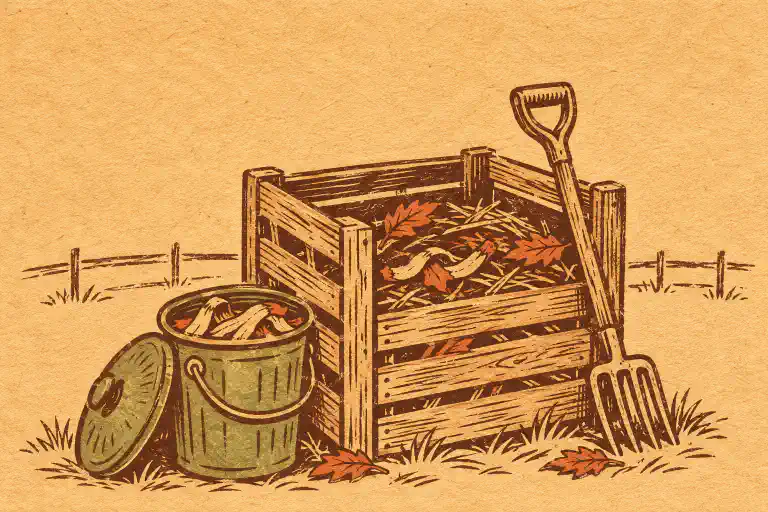
Banana peels go in the compost bin. They’re a green: EPA counts “Fruit and vegetable scraps” among the greens for a backyard pile, and Penn State Extension lists “Fruit and vegetable peels and other fruit wastes.” How long they take is murkier: answers online run from a few weeks to two years. None of the figures we traced is for a peel in a bin (why).
Quick fix
- Add them as a green. Count them with your other kitchen scraps, and, as EPA advises, add at least two to three buckets of browns per bucket of greens, by volume (browns and greens).
- Chop or tear them before they go in (how).
- Bury them in the pile, under browns, not on top.
Then judge the pile, not the peel: Is my compost ready?
How long does a banana peel take to decompose in a compost bin?
Sources time the whole pile, not a single scrap. None of the pages we read, including EPA, Penn State Extension, University of Maryland Extension and the National Park Service pages below, gives a time for a banana peel in a home bin. Our reading: a peel usually breaks down along with the rest of the pile. EPA says of finished compost, “Most, if not all, of the materials that went into the compost pile should be decomposed.” The pile’s time depends on how you compost:
- A well-kept pile: “Compost in a well-maintained pile will be finished and ready for use in about three to five months. Left untended, a pile may take a year to decompose.” (EPA)
- A hot bin, filled all at once: University of Maryland Extension says its hot method, ideally a bin at least 3 by 3 by 3 feet “filled all at one time” with the right mix of browns, greens, water and air, gives “a compost harvest in six to eight weeks.”
- A cool pile, with materials “added as generated”: Maryland Extension says the microbes in cool or passive composting “need about a year to complete the process,” and its comparison table says the cool method “Takes a year or more.”
In winter, Penn State says, a pile “goes dormant,” starting again once air temperatures rise above 50°F (10°C). For the whole-bin picture, see how long compost takes in a bin.
Why the answers run from weeks to years
What we could trace is about peels outside a bin, left on the ground or buried in soil, and none of it says how anyone measured:
- Dropped in a park: a National Park Service litter quiz from Golden Gate gives banana peels “3 to 5 weeks to decompose” (answers).
- Discarded outdoors: a 2021 article for UC Davis’s Campus Center for the Environment (ASUCD) puts “haphazardly discarded” banana peels at “two years,” citing “Hemphill 2019.”
- Buried in soil: Gardenia.net, a gardening site, gives no time for whole peels buried under plants, but says: “Whole peels decompose slowly, can attract rodents or raccoons, and may become a slimy pocket that repels roots.”
The first two are weeks against years for what sounds like the same setting, a peel left outdoors, and neither says what counted as “decomposed”: gone from sight, or fully broken down. Our reading: the setting and what counts as “decomposed” drive the spread. None of these describes a bin, where peels get chopped, buried, kept damp and mixed.
Are banana peels biodegradable?
Banana peels are biodegradable in the plain sense: the NPS and ASUCD sources above describe them decomposing (our reading), and the ASUCD article cites the Oxford Dictionary’s definition, “a substance capable of being decomposed.”
On a label, the word means more. For products marketed with an unqualified biodegradable claim, the FTC’s Green Guides expect evidence that “the entire item will completely break down and return to nature (i.e., decompose into elements found in nature) within a reasonably short period of time after customary disposal.” That’s a test for marketing claims, not a rule about peels.
Our reading: “biodegradable” says a peel can break down, not how fast (how to help it along).
How to add banana peels so they break down faster
- Collect them in a lidded caddy until you’re ready to take a load out to the bin. EPA suggests a closed container in the kitchen; a small pail such as the OXO Good Grips 1.75-gallon compost binad does the job.
- Chop or tear them. Smaller pieces “help the materials in the pile break down faster,” EPA says of scraps in general. Gardenia.net, on banana peels specifically, says to “Cut peels into strips for faster breakdown,” then add them to an active pile with plenty of leaves or shredded paper. None of the pages we read gives a size for peels.
- Bury them under the browns. Mix them in at the ratio above. Maryland Extension says “it can be helpful to mix in a dry, high-carbon material, such as leaves, sawdust, or shredded paper, to reduce odors and facilitate decomposition.” Our advice: work them in with a spading fork, such as the Truper 4-tine spading forkad.
- Keep it damp. Our test: a squeezed handful should hold together without dripping. If a pile is too dry, EPA says, “activity in the pile will slow or cease” (compost too dry).
- Turn it now and then. Turning “will help speed up the decomposition process and aerate the pile,” EPA says. How often to turn compost has the schedule by bin type.
Tumbler or closed bin? Our advice: chop the peels and spin the tumbler; in a closed bin, work them down from the top.
Stickers and fruit flies
- Stickers: peel the sticker off first. EPA lists “Produce stickers” among things to keep out of a backyard pile, and “items like produce stickers and plastic” among what to sift out of finished compost.
- Fruit flies: Our advice: keep peels buried, as in the how-to steps above. For little flies around the bin, see bugs in the compost bin; for swarms of fruit flies or rats, see pests in the compost bin.
If that didn’t work
- Has the pile had the time your method takes (see the list above), outside winter, without shrinking or darkening? Our reading: it has stalled. Work through compost not breaking down.
- Is it compost yet? Look for the pile shrinking and darkening, not a date: Is my compost ready?
- Meat, dairy or grease in the scrap bucket too? See what not to add.
Got another scrap to check? Can I compost it? covers eggshells, citrus and bread.