What can you compost? The browns and greens list
Which materials count as compost browns, which count as greens, and the rough two-or-three-to-one ratio to aim for between them.
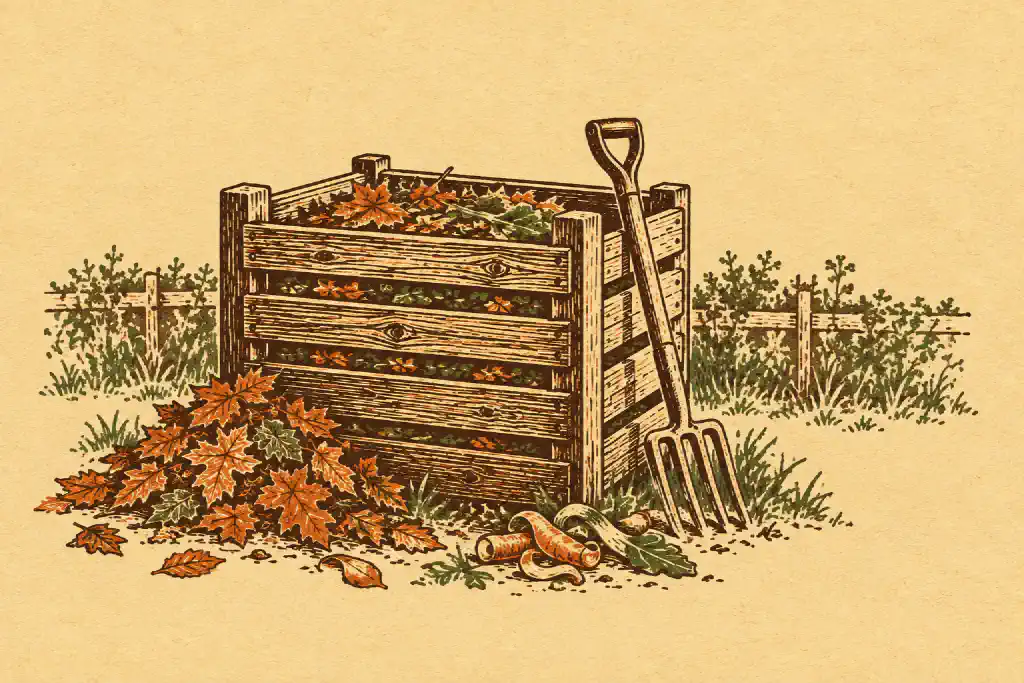
Many compost problems — smell, sogginess, a pile that won’t start — trace back to the balance between two broad categories of material: browns and greens. This page is the reference: what falls into each, and roughly how much of each to use.
Quick fix
- Browns are dry and carbon-rich: cardboard, dry leaves, straw, paper.
- Greens are moist and nitrogen-rich: kitchen scraps, grass clippings, fresh weeds.
- Aim for roughly two to three parts browns to one part greens by volume, not by weight.
The reference list
| Browns (carbon) | Greens (nitrogen) |
|---|---|
| Cardboard, torn or shredded | Kitchen scraps (fruit, vegetables, peelings) |
| Dry leaves | Coffee grounds and tea leaves |
| Straw | Grass clippings |
| Plain paper, shredded | Fresh weeds (not gone to seed) |
| Wood chips | Manure from horses, rabbits and poultry |
| Sawdust (from untreated wood only) |
Browns tend to be dry, tan or gray in color, and slow to break down on their own. Greens tend to be moist, brightly colored, and quick to break down — often too quick, which is exactly why they need browns to balance them.
Why “browns” and “greens” are useful shorthand
The property that matters underneath is the ratio of carbon to nitrogen in the material. Almost nobody measures that at home, and you don’t need to. Dry, woody, fibrous material is reliably high in carbon; fresh, moist, recently-alive material is reliably high in nitrogen. The color shorthand tracks the underlying chemistry closely enough to be useful without a lab test.
The rough ratio
A sensible starting point is two to three parts browns to one part greens, measured by volume (a bucket of one against a bucket of the other), not by weight, since greens are heavier for their volume and weighing them would throw the ratio off. If you’ve compared composting charts and found numbers that don’t remotely agree, the charts are the problem, not you: some describe the chemistry (carbon to nitrogen), others describe buckets (browns to greens), and the two scales give very different figures. You don’t need either as a formula. Treat 2:1–3:1 by bucket as a starting ratio to correct toward, not a rule to measure out with scales. A pile that smells of ammonia or feels slimy and wet needs more browns. A pile that’s bone dry with nothing happening has gone too far the other way, or simply needs water alongside more greens.
Why ratio is a guide, not a rule
Materials vary within each category. Fresh grass clippings are wetter and more nitrogen-heavy than a fresh weed pulled from dry soil; cardboard holds its structure differently from dry leaves, which pack down more. Two piles built to the same “ratio” by two different people, from different materials, can behave quite differently. So start at 2:1–3:1, then adjust by what you observe: smell, moisture, and how fast the pile is shrinking are all better feedback than chasing an exact number.
A pile doesn’t need a perfect ratio to turn out dark, crumbly compost — the black gold everyone is chasing. It just needs to be in the right general range. Most of the guides on this site for specific problems (smell, sogginess, a stalled pile) come back to nudging this balance one way or the other, because it’s the single biggest lever you have over how a home compost pile behaves.
A practical habit
Keep a stash of browns — a bag of dry leaves, a stack of flattened cardboard — sitting next to the pile, so that every bucket of kitchen scraps gets a matching handful or two of browns mixed in on the spot. That one habit heads off more compost problems than almost anything else on this site. If a bin has already stalled, match what you see inside it to find the fix.