Can I compost it? Eggshells, wood ash, sawdust, pine needles, citrus, bread and weeds
Eggshells, untreated sawdust: yes. Citrus: yes in a pile, not a worm bin. Wood ash, bread: a little. Weeds gone to seed: keep out. Pine needles: sources split.
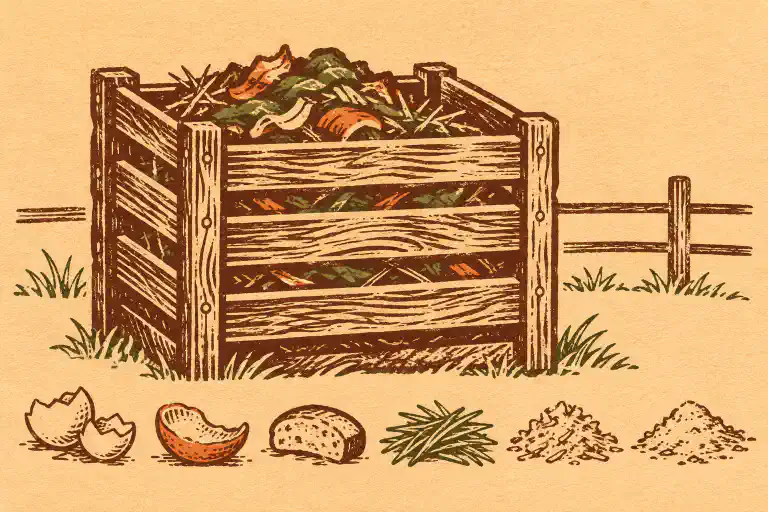
Seven items people often ask about, each with a straight answer. For the list of things to keep out, see what not to put in a home compost pile. For the mix, see browns and greens.
Quick answers
| Item | Compost it? | The catch | Brown or green |
|---|---|---|---|
| Eggshells | Yes | Crush them | Green, on EPA’s list |
| Wood ash | A little | Cold, from untreated wood; how little depends on the source | Not classed by our sources |
| Sawdust | Yes | Untreated wood only | Brown |
| Pine needles | Sources split | NC State: leave out; Detweiler: no more than 10 percent | Brown (our reading) |
| Citrus peels | Yes, in a pile | EPA keeps citrus out of worm bins, not piles | Green |
| Bread | A little | Small amounts, buried | Not classed by our sources |
| Weeds | Yes, before they seed | Weeds gone to seed and invasive roots stay out | Green when fresh (our reading) |
Eggshells in compost
Yes. Crush them first, and count them as a green: like coffee grounds, they’re a green that doesn’t look like one. The EPA lists “Eggshells (crushed)” with its greens. NC State Extension lists “Eggshells and crustacean shells” among things to add, while keeping whole eggs out, along with meat and dairy.
Shells are slow, so don’t worry if bits survive. EPA says to sift finished compost for “materials that didn’t break down,” eggshells among them, and adds: “Pits, eggshells, etc. that you sifted out can be added back into the active pile or to a new pile.”
EPA suggests keeping fruit and vegetable scraps “in a closed container on your kitchen counter, under your sink, or in your fridge or freezer.” Our advice: shells can go in the same pail, such as the OXO Good Grips 1.75-gallon compost binad.
Wood ash in compost
A little, from untreated wood, and only once it’s cold. The three extension sources agree on a small amount and differ on how small:
- NC State puts wood ash on its list of things that “should not go into compost piles,” then adds: “a handful or two may be added, but too much may harm microbes, slow the composting process, cause smelly ammonia gas releases, and reduce nitrogen.”
- Iowa State Extension: “Add wood ashes sparingly to compost piles. No more than 5% of the total volume should be ashes, as high pH can harm compost microorganisms. Less is better to avoid disrupting the balance of the compost.”
- University of Vermont Extension: “Wood ash can be added in very small quantities to compost piles, keeping an eye on the pH.” It adds that the key is “knowing the pH of your compost pile before you add wood ash and spreading a thin layer of ash across the pile (versus dumping it in).” UVM doesn’t say how to check.
Iowa State says: “Never use wood ashes from the burning of treated or painted wood, and never use ashes from the burning of other materials (such as garbage).” NC State keeps “Charcoal ash or coal” out of the pile.
Two cautions:
- Fire. For fireplace ashes, Virginia’s Fairfax County Fire and Rescue Department says: “You should always place discarded fireplace ashes in a sturdy metal container, dampen them with water, and cover the container with a metal lid.” It adds that “Ashes should be stored in a metal container outside, away from the house, to cool.” And: “Never dump fireplace ashes until they have had at least four days to cool.”
- Skin. Iowa State warns: “Wood ashes can be caustic, so avoid contact with the skin. Protect yourself by wearing long sleeves and pants, gloves, eye protection, and a mask to prevent any issues.”
Sawdust in compost
Yes, from untreated wood. It’s a brown, as browns and greens explains. CalRecycle, California’s recycling agency, lists “Untreated wood chips and sawdust” among its browns. NC State lists sawdust as a brown too, and its list of things to add names “Sawdust from deciduous hardwood trees.”
Both EPA and NC State keep treated wood out: EPA’s avoid list has “Treated or painted wood,” and NC State’s has “Pressure-treated lumber, pressed wood, plywood (contain toxic chemicals).”
Cornell’s table puts “wood chips or sawdust” at 100–500 parts carbon to 1 of nitrogen, and it says the ideal ratio for composting “is generally considered to be around 30:1, or 30 parts carbon for each part nitrogen by weight.” To check the rest of your mix by weight, try the compost ratio calculator.
Our advice: mix sawdust through your greens rather than adding a thick layer of it. It also soaks up a wet pile: NC State’s fix for too much moisture is to “add dry leaves, paper, or sawdust.” See compost too wet.
Pine needles in compost
The sources split, though both sides agree the needles rot slowly. NC State keeps them out of the pile: “Pine needles (waxy coating resists decay).”
Amy Jo Detweiler, a horticulturist with Oregon State University Extension, says they can go in. She’s quoted by JoAnne Skelly, an Extension educator emerita at the University of Nevada Cooperative Extension, in her Carson Now column: “You can also add them to a compost pile; they will slowly break down over time. If you run them through a shredder, they will break down faster. A general rule of thumb is not to add more than 10 percent of pine needles to your compost pile.”
Do they make things acidic? The extension sources call that a myth, but only for soil and mulch, not compost. Oregon State says “Pine needles have a low pH when fresh, but as they decompose, soil microbes neutralize them.” UNH Extension says they “do not have the capacity to appreciably lower the soil pH.” None of our sources measured compost made with pine needles. NC State’s reason for keeping them out is the wax, not acid.
Our advice: if you add them, shred them and keep them a small share of the pile, as Detweiler suggests.
Citrus peels in compost
Yes, in a backyard pile. In EPA’s guidance, avoiding citrus is a worm-bin rule. EPA counts “Fruit and vegetable scraps” as greens for a backyard pile, and NC State lists “Fruit and their peels.” EPA’s worm-bin advice is different: “Avoid citrus fruits,” it says, along with onions, garlic and other foods. EPA gives no reason, and none of our sources says citrus harms a pile.
Banana peels are a green too; for how long they take, see how long a banana peel takes to decompose.
Can you compost bread?
Yes, a little, buried. Sources hold back for two reasons: pests and, per EPA, piles that don’t get hot enough. EPA puts “Cooked food (small amounts are fine)” on its list of things to avoid, with two notes: “These foods can attract animals,” and “Backyard composting piles generally do not reach high enough temperatures to fully decompose these materials.” EPA doesn’t name bread; we read it as cooked food.
CalRecycle is similar: “Do not compost meat, dairy, or a lot of baked goods in home compost.” NC State goes further and lists “Bread, tortillas, pitas” among materials that “may be added to your compost bin,” with this rule: “Food scraps should be buried inside the pile to avoid attracting rodents.”
How deep? EPA’s general advice: “Always ensure your food scraps are covered by four to eight inches of dry leaves or other browns.” Our advice: while rats or mice are visiting the bin, add none, and work through rats in the compost bin first.
Can you compost weeds?
Fresh weeds that haven’t gone to seed, yes: they’re on the greens side of browns and greens. Weeds gone to seed and weeds with spreading roots stay out. NC State’s keep-out list includes “Weeds that have gone to seed” and “Weeds with invasive roots, such as dock weed, alligatorweed, or bermudagrass”; EPA’s avoid list has “Aggressive weeds/weeds with seeds” and “Herbicide-treated plants and grass.” What not to add sends weeds gone to seed to a city or county yard-waste collection.
How much heat kills weed seeds? The sources differ:
- NC State: piles “must surpass 145°F to destroy most weed seeds.” It gives no time.
- CalRecycle: “Heat to >131°F to kill seeds and germs.”
- Texas A&M AgriLife lists hours to kill 90 percent of seeds for six weeds. Two of its rows:
| Weed | Hours at 140°F | Hours at 122°F |
|---|---|---|
| Annual sowthistle | <1.0 | 2.1 |
| Black nightshade | 2.9 | 62.0 |
Does a home pile get that hot? Texas A&M says: “Properly managed, a compost pile should easily reach 140°F, which breaks down all organic matter, including weed seeds. The key word is properly.” Iowa State is less hopeful: “The temperatures in home compost piles seldom get high enough to kill weed seeds and disease pathogens.” It suggests sending weeds that are producing seeds to a municipal or commercial composting facility. Oregon State says much the same about cold piles and weed seeds.
To check that a pile is heating, CalRecycle says to “Use a compost thermometer with a long stem.” A long-stem compost thermometer, such as the Reotemp 20-inch compost thermometerad, does that job. Our advice: whatever the reading, keep weeds gone to seed out. A hot reading tells you the pile is working, not that every seed is dead.
Still not sure?
- Meat, dairy, pet waste or diseased plants? For meat, bones, fish and dairy, see can you compost meat and dairy?; for the rest, see what not to put in a home compost pile. For dog poop, see dog poop in compost.
- Coffee grounds and filters? See coffee grounds in the compost bin.
- Paper, cardboard, tape or receipts? See paper and cardboard in compost.
- Unsure if a load is too heavy on browns or greens? The compost ratio calculator checks the mix by weight. It has fruit and food scraps, leaves, grass and cardboard; eggshells, wood ash, sawdust and pine needles aren’t on its list.