Coffee grounds in the compost bin: a green, how much to add and filters
Used coffee grounds are a compost green. Extension sources advise no more than 20% of the pile by volume; mix big loads with browns and add filters too.
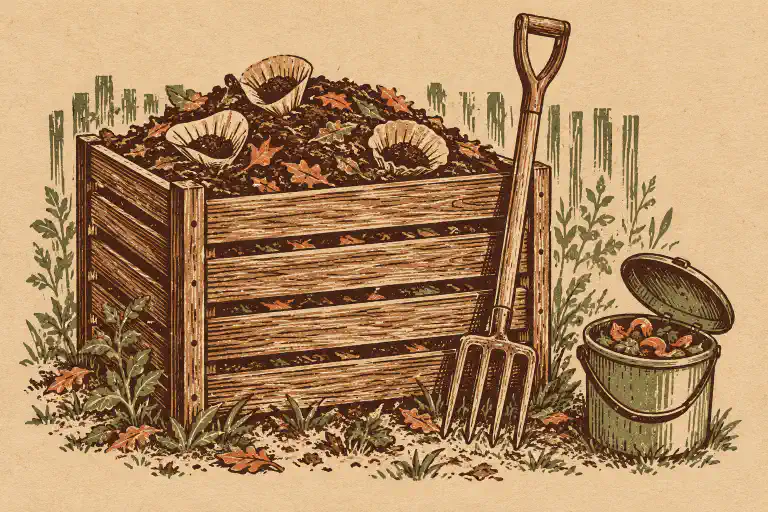
Yes, used coffee grounds go in the compost bin. If the advice online seems contradictory, it is: guides disagree on whether grounds are a green or a brown, how much a bin can take, and whether they make compost acidic. Extension and university sources answer the first two and narrow down the third.
Quick fix
- A daily pot’s worth? Let it cool, then mix grounds and paper filter in with browns (how).
- How much? No more than 20% of the pile by volume (details).
- A big bag from a coffee shop? Add it in batches mixed with browns, not as one thick layer (the fix).
- Wet or smelly after adding grounds? See compost too wet, or match the smell: sharp like ammonia or sour.
- Pods? Empty the grounds into the bin. The pod goes where its label says (pods).
Are coffee grounds green or brown?
Green. They’re brown to look at, but rich in nitrogen, which is what “green” means in a compost bin. Cornell’s Compost Chemistry page lists coffee grounds at 20 parts carbon to 1 part nitrogen (20:1) among its “Materials High in Nitrogen.” NC State Extension’s table agrees.
“Green” and “brown” are a rule of thumb based on looks. Cornell puts it this way: “In general, materials that are green and moist tend to be high in nitrogen, and those that are brown and dry are high in carbon.” Grounds break that rule: brown, but at 20:1 well below the roughly 30:1 Cornell gives as ideal for a pile.
How much coffee grounds in a compost bin?
WSU and OSU Extension agree. In WSU’s Using Coffee Grounds in Gardens and Landscapes, Linda Chalker-Scott writes: “Use no more than 20 percent by volume of coffee grounds in a compost pile.” She adds: “Excessive coffee grounds in composts can be phytotoxic.” OSU Extension says: “Coffee grounds should make up no more than 20% of the pile’s total volume — higher amounts can be toxic to plants.”
Grounds count on the greens side of the everyday mix: two to three buckets of browns for every bucket of greens, by volume (browns and greens).
How to add coffee grounds and filters
- Collect them. The EPA suggests keeping fruit and vegetable scraps “in a closed container on your kitchen counter, under your sink, or in your fridge or freezer,” and grounds can share it. A small lidded pail, such as the OXO Good Grips 1.75-gallon compost binad, holds them until you take them out.
- Let them cool. WSU: “Be sure to allow coffee grounds to cool before adding them to your compost; heat can kill your beneficial microbes.”
- Mix them in with browns. Work grounds and filter through the pile with browns at the ratio above. Our advice: if you use a tumbler, give it a spin.
- Squeeze a handful. It should hold together without dripping. If it drips, see compost too wet.
Can you compost coffee filters?
Yes. EPA lists “Coffee grounds and paper filters” among its greens, NC State lists “Coffee grounds and filters” among things to add, and OSU says, “Coffee filters can be composted as well.”
Our advice: a used filter goes in wet and full of grounds, so count the load as a green, as EPA does, and add browns for it. None of the sources we checked says whether white (bleached) filters behave differently from brown ones. For other paper that does count as a brown, see paper and cardboard in compost.
A big bag of grounds from a coffee shop
Add it in batches mixed with browns, not as one thick layer.
Our reasoning: WSU describes grounds, as a mulch on soil, as “finely textured and easily compacted.” NC State warns, of compost materials in general, that “very fine particles will prevent air from flowing into your compost pile,” and without air, Cornell says, a pile turns anaerobic (airless) and gives off “undesirable odors.” So a thick layer of grounds is likely to go wet and airless (no source we checked tested this). The fix:
- Keep the bag closed. OSU says to “store them in a sealed container until use.”
- Add a batch at a time and mix each one in, within the 20% guideline above. NC State describes building in layers, then adds: “Another method is to thoroughly mix up browns and greens during loading.” Our advice: in a tumbler, add a little at a time and spin; in a closed bin, work the grounds in from the top with a fork.
OSU Extension says mold on stored grounds is fine for the compost: “Mold may develop, but it’s harmless in compost and contributes to decomposition.” If you have a lung condition or a weakened immune system, read the health note in mold in the compost bin first.
Already slimy? See can slimy compost be saved?.
Do coffee grounds make compost acidic?
Not reliably. OSU: “It’s a common misconception that coffee grounds are acidic. After brewing, they’re close to neutral — around pH 6.5 to 6.8.” WSU, citing studies that range from “mildly acidic” to “somewhat alkaline,” advises: “Don’t assume coffee grounds will make an acidic compost; pH levels will change over time.”
Every pile turns “more acidic” early on, NC State says, and over time “the acidity of the composted material becomes near neutral.” None of the sources we checked gives the pH of finished compost made with grounds.
A sour smell is different. For a pile that “smells like rancid butter, vinegar, or rotten eggs,” NC State’s troubleshooting table gives the cause: “The pile is too wet, or there is not enough air, or there is too much nitrogen.” Our reasoning: a heavy load of grounds adds a lot of nitrogen, and once packed down it can hold water and shut out air (see the coffee-shop section). Turn the pile and mix in browns: see the sour smell.
Coffee pods and “compostable” pods
The grounds inside a pod compost like any others; the pod itself depends on what it’s made of.
- K-Cups: Keurig says to let the pod cool, peel off the lid, “Compost or dispose of grounds,” and check locally to recycle the cup, which is “recyclable polypropylene (#5 plastic)” but “not recycled in many communities.”
- “Compostable” pods: under the FTC’s Green Guides, a compostable claim needs evidence that “all the materials in the item will break down into, or otherwise become part of, usable compost” in “a safe and timely manner.” That can be “in an appropriate composting facility, or in a home compost pile or device.” In one FTC example, a package that won’t break down at home should say it is “not suitable for home composting.” Our reading: if a pod’s label names commercial or industrial composting only, it isn’t meant for your bin.
- Backyard bins: EPA keeps “Compostable foodservice ware and compostable bags” out of backyard piles, which “generally do not reach high enough temperatures to fully decompose these materials.” EPA doesn’t name pods, and no source we checked tested one at home.
Coffee grounds straight on the garden
Extension sources split on fresh grounds in garden soil: WSU says “Fresh grounds are demonstrably phytotoxic to a variety of plants,” so their “use as an amendment or mulch is not recommended,” while OSU’s Linda Brewer “recommends working in a half inch of grounds to a depth of 4 inches.” Composting them first avoids the question.
If that didn’t work
- Smells sharp, like ammonia? See why your compost smells.
- Wet or slimy? See compost too wet.
- Balancing the rest of the pile? The compost ratio calculator checks leaves, grass and other materials against the 30:1 target (coffee grounds aren’t on its list).
- Fuzz on the grounds in the bin? See mold in the compost bin.
- Eggshells, bread or other kitchen scraps? See Can I compost it?.