Can compost catch fire? Steam, heat and when to worry
In the right conditions, compost can catch fire. A working pile can steam; smoke means call 911. How hot a pile should get, and how to cool it.
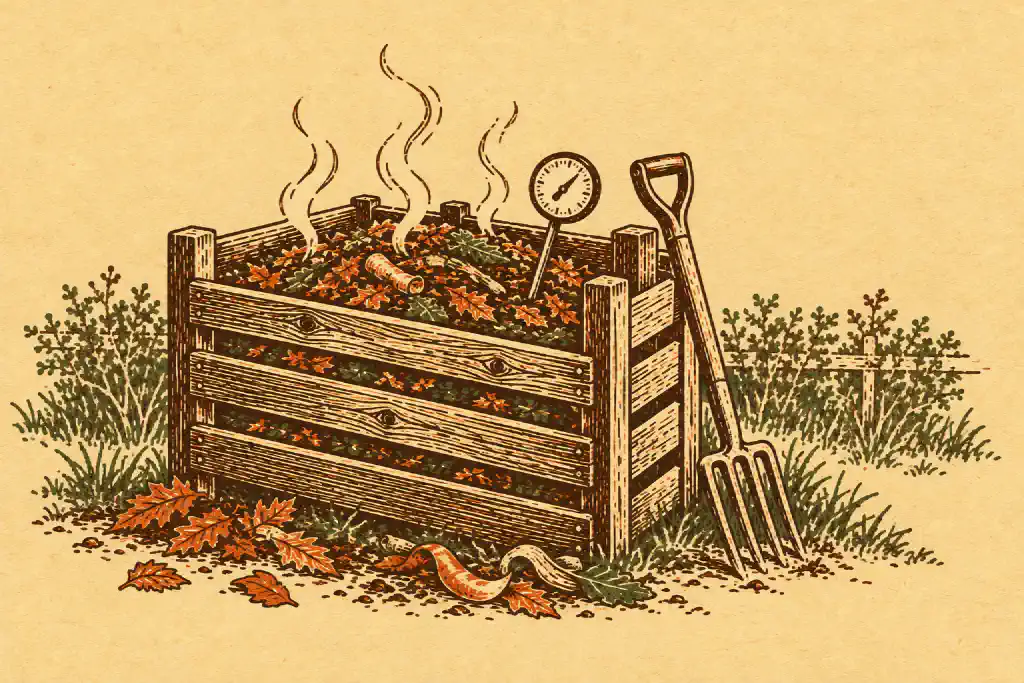
Steam pouring out of the bin, or a thermometer reading that looks far too high, can be alarming. One poster on a Houzz forum wrote: “My wife had a kitten when she saw the thermometer on this compost pile, she has heard stories of compost piles bursting into flames!” So can compost catch fire? Where the US sources below (the National Park Service and university extension services) describe compost fires, they describe large piles.
Quick fix
- Steam on a cold morning, with no smoke? That’s most likely heat from a working pile. Our advice: unless a thermometer reads over 140°F (60°C), steam on its own needs no fix.
- Thermometer over 140°F (60°C)? Turn it and check it isn’t dry: see How to cool down a hot compost pile.
- Smoke? Call 911, then see Smoke, not steam. Our advice: treat a burning smell as smoke.
- Never gets warm at all? That’s the opposite problem: Compost not heating up.
Why is my compost steaming?
A University of Georgia article on composting fallen leaves says the pile “will create heat and may reach high temperatures that cause steam to come from the pile on cold winter days.”
Our advice: steam is warm, damp air from inside the pile meeting cold air, so you’ll see it most on a cold morning or when you turn the pile. If you can’t tell steam from smoke, treat it as smoke.
How hot does compost get?
- A target for a home pile. Nick Andrews, who works in organic vegetable extension at Oregon State University, said a pile “should reach 130–135°F” (about 54–57°C) to kill weed seeds and many pathogens. The Oregon State Extension article suggests 0.5 to 1 cubic yard of fresh material. That’s a goal, not a limit.
- The fastest range. Cornell Cooperative Extension’s operator fact sheet on temperature says “Decomposition is most rapid when the temperature is between 90° and 140° F (32 - 60° C).” Above 140°F (60°C), it says, “most microorganisms cannot survive.”
- The too-hot point. Compost can get too hot: above 160°F (71°C), the same sheet says, “the compost can sterilize itself, killing off the beneficial microorganisms.”
Our advice: to know your pile’s number, push a long-stem compost thermometer into the middle.
Why does compost heat up after grass clippings?
Cornell’s temperature fact sheet counts summer grass clippings among high-nitrogen wastes. Its fix is in step 3 below.
Our advice: a big load of fresh, nitrogen-rich grass gives the organisms in the pile a lot to feed on at once, so the heat can climb fast. To head that off, add clippings in thin layers mixed with browns, aiming for 2–3 buckets of browns to 1 of greens. Browns and greens lists what counts as each. A thick, wet mat can go slimy instead: Can slimy compost be saved?.
Can compost catch fire?
In the right conditions, yes. The US National Park Service’s fire-prevention guide lists “large compost, mulch, manure, and leaf piles” among things that “can spontaneously combust in the right conditions.”
Cornell’s health and safety fact sheet for municipal yard-waste sites says “Fires are rarely a problem in outdoor composting operations.” But “if the material does dry out and gets too hot, combustion can occur.” For that, the material has to heat past 200°F (93°C), “which typically requires a pile over 12 feet high.”
Rutgers Cooperative Extension, writing about a fire in a large manure pile, put the risk at a pile temperature of “probably 180º Fahrenheit or higher,” made worse by hot weather.
During the UK’s 2022 heat wave, Gardeningetc reported London Fire Brigade advice for a compost-bin fire: call 999 (the UK’s emergency number), move a safe distance away and don’t try to tackle it yourself. It also quoted Morris Hankinson of Hopes Grove Nurseries: “a dry heap will not break down, and this just poses a fire risk.”
Our advice: in hot weather, don’t let your pile dry out. The Park Service also advises keeping piles away from buildings, in case a fire occurs.
Smoke, not steam: what to do
The Park Service is direct: “Dial 911 or your local fire emergency number if your hay bales or mulch, leaf, manure, or compost pile is emitting smoke.” Spreading the material out lets the heat escape, it says, “but the introduction of oxygen can result in an immediate fire,” so firefighters should be on hand.
Our advice: don’t dig into a smoking pile, spread it or open the bin to look. Keep people and pets back and wait for the fire department.
How to cool down a hot compost pile
If your thermometer reading is high, or you’ve just added a big load of greens and the pile is hot:
- Turn it. Cornell’s temperature fact sheet says “Turning the compost when temperatures exceed 140° F (60° C) can prevent both these potential problems” (the pile sterilizing itself and, at operator sites, spontaneous combustion). Turning lets in air, which the sheet says can set temperatures rising again, so keep checking. Our advice: fork an open pile through, work an aerator down through the lid of a cone bin, or give a tumbler a spin.
- If it’s dry, rewet it. Dry and hot together is the combination Cornell’s municipal sheet links to fires (see above). Our advice: squeeze a handful from the middle. If it crumbles instead of holding together like a wrung-out sponge, water each layer as you turn it. Compost too dry has the method. If it passes the squeeze test, don’t add water.
- Make it smaller. For grass clippings, the sheet says “smaller piles and frequent turning are needed to both provide oxygen and release excess heat.” Our advice: in a home bin, hold off on big loads of greens until it settles. If you have room, move some into a second pile.
If that didn’t work
- Cooled it down and now it’s gone cold? That’s fine. Compost not heating up explains why a cold bin still makes compost.
- Still over 140°F (60°C) after turning, or still climbing? Make sure you’ve split it (step 3). Smoke at any point? See Smoke, not steam.
- Smells of ammonia after a load of grass? Why your compost smells.
- White threads in a dry spot? Mold, fungus or mushrooms in the compost bin.