Compost vs fertilizer, mulch, topsoil and manure: what's the difference?
Compost improves soil but has low fertilizer value; vegetables and lawns often still need fertilizer, per a soil test. Mulch covers soil; topsoil fills beds.
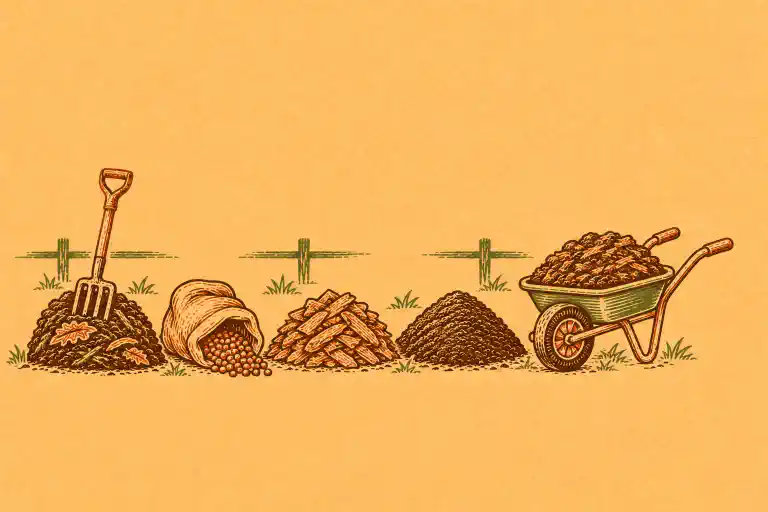
Compost is a soil amendment that feeds soil organisms and helps soil take in and hold water, but its fertilizer value is low. Raw or aged manure is an ingredient with food-safety rules for vegetable gardens. For how much compost a bed or lawn needs, use the compost calculator.
Compost, fertilizer, mulch, topsoil and manure side by side
*Our summary.
Compost vs fertilizer
A soil test tells you which nutrients your soil needs and how much; fertilizer supplies them in measured amounts. So is compost a fertilizer? Not really: it contains nutrients, but it’s a soil amendment (more in is compost a fertilizer?).
The three numbers on a fertilizer bag are the guaranteed percentages, by weight, of nitrogen, phosphate and potash. Synthetic and organic fertilizers both carry their nutrients as salts, and a large amount left in contact with roots can injure them (“burning”). Compost releases its nutrients slowly: plant-based compost releases 5–10% of them in the season it’s applied, against 85% for fish emulsion.
Every 3 to 4 years, depending on circumstances, send a sample to a soil testing lab to check nutrients, organic matter and pH. Your local Cooperative Extension office has soil test boxes and instructions. Without a test, follow the fertilizer label.
Compost vs mulch
Mulch is a job, not a material: anything spread on the soil surface to protect or improve it, and compost can do that job. Common organic mulches include bark, wood chips, leaves, pine needles, grass clippings and straw.
How long a mulch lasts depends on what it’s made of. Organic mulches decompose over time and need replacing: grass clippings and leaves break down very fast and straw rapidly, while pine needles and bark last about 2 to 4 years. Small wood chips decompose very rapidly, using nitrogen from the soil that then needs replacing with nitrogen fertilizer. Inorganic mulches such as gravel, pebbles and landscape fabric don’t decompose.
Whether compost on its own keeps weeds down is where the guides disagree: see compost as mulch.
Compost vs topsoil
Topsoil gives a bed its mineral content, structure and weight, and compost adds organic matter and holds moisture. For a new raised bed, a blend of the two works better than either alone (what to fill it with).
Bagged topsoil usually comes already amended with lime, fertilizer and organic matter; bulk topsoil is generally native soil sold by the truckload.
Either way, “topsoil” isn’t a guarantee of quality: it can be dense, stony or low in organic matter. Before you buy, ask:
- Where did it come from?
- Has it been screened?
- What job is it meant for: lawn repair, general grading or a vegetable garden?
- Is compost mixed in, and how much?
If you’re buying a lot, have it tested (how to get a soil test), and test for lead or pesticide residue if there’s reason for concern. If the real problem is pH or fertility, more soil may not help much.
Compost vs manure
Manure is a raw ingredient and compost is the finished product, and raw manure on a vegetable garden comes with waiting periods before harvest. In a pile it counts as a green, though guides split on whether it belongs in a home pile at all (browns and greens).
Manure vs fertilizer: manure is a soil amendment, not a fertilizer, unless it’s a commercial product that’s processed, tested and labeled as one. It’s rich in nitrogen, phosphorus and potassium, but it takes a lot to meet plants’ needs, and the content varies widely. Manures and composts often carry more phosphorus than nitrogen, so years of heavy use can push phosphorus well above what plants can use; a soil test shows it.
Compost made from manure may have high soluble salts; see the cautions before you use it.
Raw manure in vegetable gardens: waiting periods and safety
Manure can carry bacteria such as E. coli, Salmonella and Listeria, plus roundworms and tapeworms, which can pass to people on fresh fruit and vegetables.
- Wait before harvest. For raw or aged manure, UNH Extension says to wait at least 120 days before harvesting crops that grow in or near the soil (root crops, leafy greens, strawberries), and at least 90 days for other crops. UMaine Extension gives the same 120 days for raw manure on crops that could touch the soil.
- The USDA organic rule. For food crops, the USDA organic standard requires organic producers to compost raw manure unless it’s incorporated into the soil at least 120 days before harvest when the edible part touches the soil, or 90 days when it doesn’t.
- Aged isn’t composted. “Aged manure is not the same as composted manure.” Killing pathogens takes 131°F to 140°F for several weeks, with regular turning, and home piles rarely get there. Composting manure with yard waste does reduce the risk, and reaching 140°F reduces it further.
- Check bagged manure: the package should say if it’s pathogen-free.
- Once plants are growing, never sidedress them with raw manure (spread it beside the plants); use only pasteurized or actively composted manure.
- Never use cat, dog or pig manure in a vegetable garden or a compost pile. These are more likely to carry parasites that infect people (more on dog poop).
- Watch for herbicide residue. Some broadleaf herbicides used on lawns, turf, pastures and hay can stay active even after passing through an animal and after the manure is composted. They can injure tomato and other solanaceous (tomato-family) crops, lettuce, beans and other legumes, strawberries, grapes, and most other vegetable crops. When you buy manure or compost, get assurance that herbicides aren’t present.
- Wash produce. Wash all produce from manured beds well before eating, and peel where you can. Washing with clean water and peeling removes most pathogens, and fully cooking kills the rest. Risk is highest for crops whose edible parts touch the soil, such as radishes, carrots and lettuce.
- Skip uncooked vegetables from manured gardens if you’re at higher risk. UMaine names pregnant women, the elderly, very young children, and those with health issues such as cancer, kidney failure, chronic liver disease, diabetes, or AIDS.
Which one do I need?
Our short version, by job:
- Filling a new bed: topsoil or a bought blend, with compost mixed in (compost vs topsoil). Then size the compost with the compost calculator: pick a new-bed depth, and for a raised bed don’t enter its full height (see what to fill it with).
- Feeding hungry plants: a soil test, then fertilizer to match, with compost alongside (compost vs fertilizer).
- Covering bare soil: mulch. Compost works, or bark, leaves or straw (compost vs mulch).
- Improving heavy clay or sandy soil: compost mixed in, which improves drainage in clay and water holding in sand (how to use compost).
- Using up your own pile: check it’s finished, then work out how much your beds need with the compost calculator below and compare it with what your pile holds.
- Got manure? Raw or aged manure on a vegetable garden needs a wait before harvest, and a home pile rarely stays hot enough, for long enough, to be sure the pathogens are dead.
To work out how much compost a bed or lawn needs: