Composting leaves: make leaf mold or use them as browns in the bin
Fall leaves can become leaf mold in their own pile or browns for the compost bin. Which to choose, how to do each, and why a leaf pile stalls.
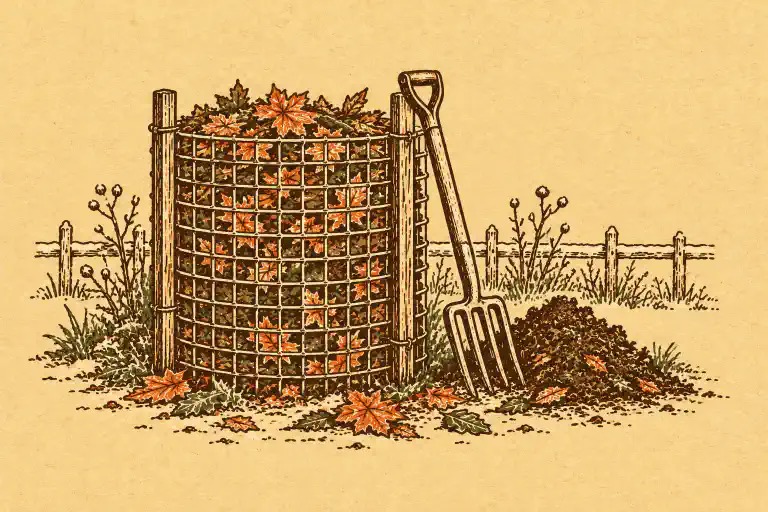
If you’re figuring out how to compost leaves, you may already have last year’s pile in a corner, looking much as it did when you raked it. That isn’t a failure. Leaves are low in nitrogen, so a pile made mainly of leaves decomposes slowly (Iowa State University Extension). You have two routes: a leaf-only pile that turns into leaf mold, or leaves as the browns in your compost bin.
Quick fix
- No bin, or don’t want leaves in it? Make leaf mold in a pile, a wire ring or bags.
- A bin, and a few bags’ worth? Put them in the bin as browns (see what counts as a brown), and bag the rest for later.
- A bin, and more leaves than it can take? Do both: feed the bin, and stockpile the surplus in a separate pile. Whatever you don’t use slowly becomes leaf mold.
- Black walnut, oak or evergreen leaves, or a sprayed yard? Check which leaves need extra care first.
- Already have a matted layer or a pile that hasn’t changed? Start there.
Leaf mold or compost: what’s the difference?
Leaf mold is decayed leaves: dark brown, earthy-smelling and crumbly. It isn’t high in nutrients, but it improves soil structure and water retention and is mostly weed-free, according to Penn State Extension. UGA Extension calls it “essentially compost without the nitrogen sources like vegetable scraps or grass clippings.”
How to make leaf mold
- Pick a spot. Any out-of-the-way corner works, but not on the leaf layer in a wooded area, where wildlife shelters (Penn State).
- Size a ring, if you want one. Penn State suggests a wire or wood bin “3 to 6 feet in diameter and at least 3 feet in height.” Smaller than three feet wide and tall, a pile may dry out too fast (UGA). A 3-foot-tall roll of galvanized welded wiread bends into a ring. By our math, a ring 3 feet across takes about 9½ feet of wire; 6 feet across, about 19.
- Shred them if you can. Run over them with a mower that has a bag, or use a leaf shredder. A mower bag picks up grass too, and Cornell Cooperative Extension in Nassau County says not to compost clippings from a pesticide-treated lawn if you don’t know what was used.
- Wet them. Dampen the pile thoroughly at the start (UGA), then keep it like a wrung-out sponge: a squeezed handful holds together without dripping.
- No room for a pile? Use bags. Fill large plastic bags, moisten the leaves, tie the bags off and cut a couple of holes in the sides for air. Check them every month or two and give each a shake (UGA). 39-gallon lawn and leaf bagsad work for this.
How long does leaf mold take?
Timings differ because the piles differ.
- A pile or wire bin left over winter: shredded leaves are “ready in 6 months” and whole leaves take 9 to 12 months, says Illinois Extension.
- A heap or wire bin with very little work: “in as little as six months,” UGA says.
- Shredded, turned or watered now and then, or covered with a tarp (any one): Penn State says these speed it up “from years to 6 to 12 months.”
- Whole leaves, never managed: an unmanaged leaf bin breaks down “within a year or two,” says Cornell Cooperative Extension in Tompkins County. A compost pile of whole leaves mats together and breaks down in about two years, says the Alabama Cooperative Extension System.
Garden Organic calls leaf mold “young” at one or two years, when it crumbles easily in the hand, and well rotted at two or more, with no leaves left to see. Use it as mulch or add it to potting soil, Penn State suggests.
How to compost leaves in your bin
Dry leaves are browns, the carbon that balances kitchen scraps and other greens. Alone they’re slow, so mix them with grass clippings or other greens, and shred them first if you can (Iowa State). The Nassau County caution on clippings from pesticide-treated lawns applies here too.
Aim for two to three buckets of browns to one of greens, by volume. Moisten each layer as it goes in (Nassau County). Browns and greens has the full list. To check whether your leaves, scraps and clippings land near the 30:1 target by weight, try the compost ratio calculator, which lists leaves as a brown.
Bag the rest: dry leaves keep as browns for later (Tompkins County), ready to move into the bin in spring and summer (Penn State). Browns get scarce in winter; see stockpile your browns in fall.
Leaves matted into a flat, unchanging layer
Whole leaves “will mat together,” Alabama Extension says, and UGA explains that unshredded leaves settle into dense layers with little room for air. Squeeze a handful from under the mat, too: dry leaves need water.
Break the mat up with a garden fork and turn it through, adding water as you go. Alabama Extension’s fix for a slow leaf pile is much the same: shred, turn monthly and add water each time. In the bin, mix in greens as you turn. To rewet it, see Compost too dry.
Leaf pile hasn’t changed in months
- Whole leaves, left alone? They can take a year or two (see the timings above). Whole leaves in a mixed bin: see Compost not breaking down.
- Dry inside? Squeeze a handful from the middle. If it falls apart dry, wet the pile in layers.
- Smaller than about three feet wide and tall? UGA says a pile that size may dry up too fast. Add more leaves.
- Mostly oak or evergreen? See which leaves are slow.
- Want it faster? Use the matted-layer fix above, or move some into the bin with greens.
Which leaves are slow, acidic or best kept out
- Oak: high in tannins that slow it down, but still compostable, says a Master Gardener column on the University of California’s site. Shred them, and mix a big load with other leaves, straw or newspaper. Illinois Extension quotes retired educator Rhonda Ferree, writing about leaf mulch: fresh oak leaves are acidic (pH 4.5 to 4.7) but “break down to be neutral to slightly alkaline.”
- Other trees: none of the US extension guides we checked gives a species list beyond oak. The UK’s Garden Organic lists leaves “higher in lignin,” which it says are slower to rot: “beech, birch, hornbeam, oak, sweet chestnut and magnolia.” It advises against evergreen leaves “such as holly, laurel or conifers,” which “can take up to three years to rot down.”
- Black walnut: compost made with black walnut leaves can go on a vegetable garden, and juglone “will break down in a well-managed compost pile,” says Oregon State University Extension. Oregon State’s greatest concern is juglone reaching the soil through the tree’s roots, so consider the distance between tree and garden. Its compost advice covers a mixed pile with nitrogen added, not a leaves-only leaf mold pile. For leaf mold, UGA Extension says pecan and walnut leaves contain compounds that inhibit other plants, “so be sure that leaves from these trees are thoroughly decomposed before adding them to your garden.”
- Sprayed or roadside leaves: none of the guides we checked names leaves from a sprayed yard or raked along a road. Nassau County’s general rule: keep materials treated with a pesticide out of the compost pile when you don’t know about the residue.
If that didn’t work
- Bin smells sour or of ammonia? See Why your compost smells.
- Wet and slimy after leaves and rain? See Compost too wet.
- Cold weather and nothing moving? See Composting through winter.
Further reading
- Penn State Extension, Leaves Are Treasure, Not Trash: mulch and leaf mold.