Hot composting at home: hot vs cold, and how to build a hot pile
Hot composting: build a batch at least 3 by 3 by 3 feet at once, keep it damp and turn it as the middle cools. Not enough material? Cold composting works.
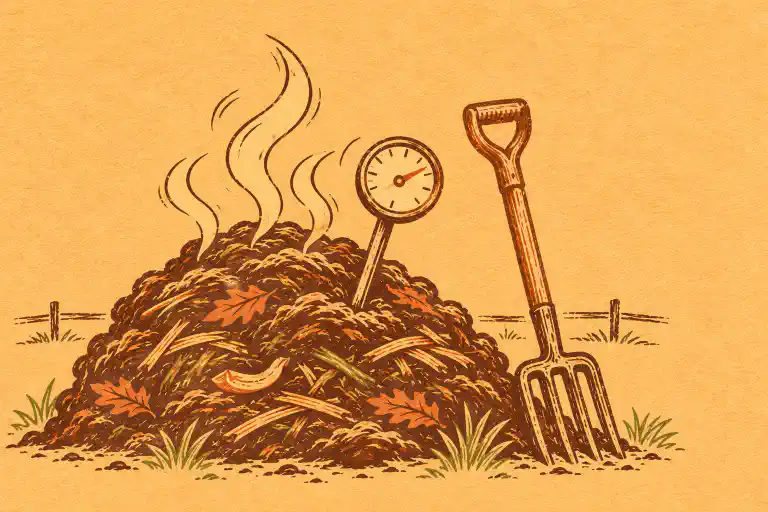
Hot composting means building one batch of browns and greens all at once, at least 3 feet wide, deep and tall (27 cubic feet). You keep it as damp as a wrung-out sponge and turn it as the middle cools. A well-maintained pile can reach 130°F to 160°F, though the sources differ on the numbers (below), and its heat helps reduce weed seeds and pathogens. It can finish in weeks to a few months. If you add scraps a bit at a time to a small bin and never turn it, you’re most likely composting cold, and that works too.
Quick answer
- Enough yard waste and scraps to fill 3 by 3 by 3 feet at once? You can hot compost: build it.
- Adding a bucket of scraps at a time to a small bin or tumbler, with no turning? That’s most likely cold composting, and it still makes compost: what to expect.
- Hoping to kill weed seeds? Most home composting units find it hard to get hot enough, so keep seeding weeds out either way (why).
- Built a hot pile and it stays cold? See If it doesn’t heat.
Hot or cold composting: which one are you doing?
The difference is how you fill the pile and how much you tend it.
| Hot | Cold | |
|---|---|---|
| How you fill it | All at once, adding no more raw material unless it isn’t working | As you go |
| Size | At least 3 by 3 by 3 feet (27 cubic feet) | Small is fine, even a 3- to 4-cubic-foot pile or bin |
| Effort | Regular checks, and turning about once a week for most gardeners | Little: no turning schedule |
| Time | Weeks to a few months (how long) | Several months to a year or more |
| Weed seeds and disease | High temperatures help reduce weed seeds and pathogens | Weed seeds and plant diseases can survive, so keep them out |
The trade-off: University of Maryland Extension counts careful attention, frequent labor and storing some materials before use among hot composting’s costs. A 1998 USDA sheet says to stockpile materials until there’s enough to mix.
One exception to the batch rule: NC State Extension counts a pile you keep adding to as one of its two styles of hot composting, so a continuous pile can heat. The build below is the batch that Maryland and the USDA sheet describe.
Our reading: if you can’t fill 27 cubic feet at once, save up materials or compost cold.
How to build a hot compost pile
Gather everything first, because a batch is built in one go.
1. Make it big enough: 3 by 3 by 3 feet
That size keeps enough heat in the middle for the pile to work. The top end differs: Iowa State says no larger than 5 by 5 by 5 feet. University of Minnesota Extension aims for about 3 to 5 feet in each direction: smaller doesn’t create enough heat, and larger lets too little air and water in.
Can you hot compost in a bin? Yes, if it holds that much and you fill it in one go. A bought bin is simply a holding unit and won’t make compost faster than a plain pile. A tumbler usually holds too little to compost hot, in Maryland’s comparison (tumbler problems). None of the sources we read tests how warm a smaller home bin gets. Our reading: a smaller bin will most likely stay cool, and that’s fine (why).
Where to put it: NC State sets a hot pile more than 6 feet from the house or other wooden structures, downhill and as far as possible from the vegetable garden.
2. Mix browns and greens
Add at least 2 to 3 times the volume of browns to greens: say, 2 or 3 buckets of dry leaves to 1 of food scraps (what counts as each). Ratios vary: NC State’s recipe is 2 to 1, and the USDA sheet says hot piles do best at 1 to 1. Mix them together, and chop pieces to under 2 inches. Leave out meat and dairy and the rest of what not to add.
To check a batch by weight, the calculator below is set to 10 lb of grass clippings and 15 lb of leaves, which it reads as about right. Change the materials and weights, in pounds, to yours. It works by weight, not by the bucket count above (why).
A mix in range doesn’t promise heat on its own: size, moisture and turning count too.
3. Wet it as you build
Aim for a wrung-out sponge: squeeze a handful, and a drop or two of water should come out. That’s about 40% to 60% moisture by weight. Water each layer as you build, because once the pile is built, it’s almost impossible to wet the center.
4. Check the middle
It should start warming within days. NC State says within a few days; Maryland says the temperature typically rises within 24 hours of filling the bin.
For a reading, push a long-stemmed compost thermometer, such as the Reotemp 20-inch compost thermometerad, into the middle, where the pile is hottest. No thermometer? Put on gloves, reach 8 to 12 inches in and feel whether it’s warm or hot. If it feels at least as hot as the hot water from your faucet, it’s doing fine.
How hot is hot? The ranges overlap, and none is the one right number:
- University of Georgia (UGA) Extension: 131°F to 160°F, a range it says also helps destroy harmful soil pathogens and weed seeds.
- NC State: a hot pile heats to 140 to 150°F. Over 130°F kills most pathogens harmful to people and pets, over 140°F destroys most weed seeds, and at 160°F the heat can kill the decomposers and slow the pile.
- EPA: a well-maintained backyard pile can reach 130°F to 160°F.
- UF/IFAS (University of Florida) Extension: composting seems to be most effective at 122°F to 131°F. It says 131°F to 140°F may be desirable to destroy weed seeds or plant pathogens but is difficult to maintain, and above 149°F many of the organisms become inactive or die. It also says most home composting units find it difficult to reach the 130°F to 140°F needed to destroy seed-laden weeds, diseased plants and nematode-infested roots, so keep those out.
- Maryland: 130°F to 170°F.
- Iowa State: most home piles reach 110°F to 170°F, with 150°F to 160°F considered ideal; it says to avoid going above 170°F, which can kill beneficial microorganisms.
- Colorado State: to kill weed seeds and plant disease pathogens, all parts of the pile should reach 145°F for at least 3 days, so the cooler outside has to be turned into the middle; 130°F only somewhat reduces them.
Large compost piles can catch fire on their own in the right conditions, and the National Park Service advises keeping them away from buildings in case a fire occurs. Smoke means call 911. Steaming hard or reading very hot? See Can compost catch fire?
5. Turn it as the middle cools
Turn the pile when the center begins to cool, moving the outside into the middle to bring in air and fresh material and get it heating again. Use a garden fork, such as the Truper 4-tine spading forkad, to work the outside inward. Colorado State University Extension says to turn when it drops below 120°F and before it passes 160°F; Maryland, before it drops below 100°F. How often varies too: against UGA’s weekly figure above, Minnesota says once or twice a month. The full schedule is in How often to turn compost.
Got more scraps? You can add a little when you turn, but generally you’re better off starting a new pile.
6. Let it cure
When turning stops heating it up, it’s curing. Colorado State counts it as curing once turning no longer lifts it above 120°F; Maryland, once the pile has shrunk to about half its volume and the temperature won’t rise again. Curing takes at least 45 days by Colorado State’s count, 2 weeks in Maryland’s steps, and 4 to 8 weeks, or 6 to 12 covered, in NC State’s. To tell when it’s done, see Is my compost ready?
How long does hot composting take?
Weeks to a few months, depending on the source and the season. UGA gives an active phase of 3 to 8 weeks, then 1 to 3 months of curing; Maryland, a harvest in 6 to 8 weeks; Minnesota, 2 to 4 months in the warm season. How long does compost take? sets these beside the cold-pile figures.
Our reading: the figures differ partly because some count curing and some don’t, and partly because of the season: composting season coincides with the growing season. In the cold months, see Composting through winter.
If it doesn’t heat
A hot pile that won’t warm may be too small, short of air or nitrogen, or too dry or too wet. It will still decompose, more slowly. To warm it up, work through Compost not heating up?
Cold composting: when it’s the better choice
Cold composting means piling materials as they come and letting them sit, with no turning schedule. It suits you if you can’t tend a pile at least every other day, have little yard waste, or aren’t in a hurry to use the compost. UGA’s table gives it 6 months to 2 years. Keep the same 2 or 3 buckets of browns to 1 of greens, and check it with the calculator.
The catches:
- Weed seeds and plant diseases can survive. Keep weeds gone to seed and diseased plants out (weeds in compost; why a cold pile doesn’t kill them). Try finished cool-pile compost in a limited area first, to be sure it doesn’t spread problems.
- Edible crops. UGA warns that “to avoid foodborne illness, the end product should not be applied directly to edible crops unless it has aged for many months or gone through a hot phase.” It can safely go on ornamental beds, trees and nonedible plants.
The upside, besides less work: cool compost is rich in beneficial organisms, and the 1998 USDA sheet says cold composting has been shown to be better at suppressing soil-borne diseases than hot composting.
Either way: have enough for a 3-by-3-by-3-foot batch? Build it and check the middle with a thermometer. If not, keep composting cold, and use the calculator to keep the mix right.