How often to turn compost (and when you don't need to)
A small home bin needs no turning schedule; turning speeds it up and fixes a wet or smelly bin. Turn a pile that heats up as its center cools.
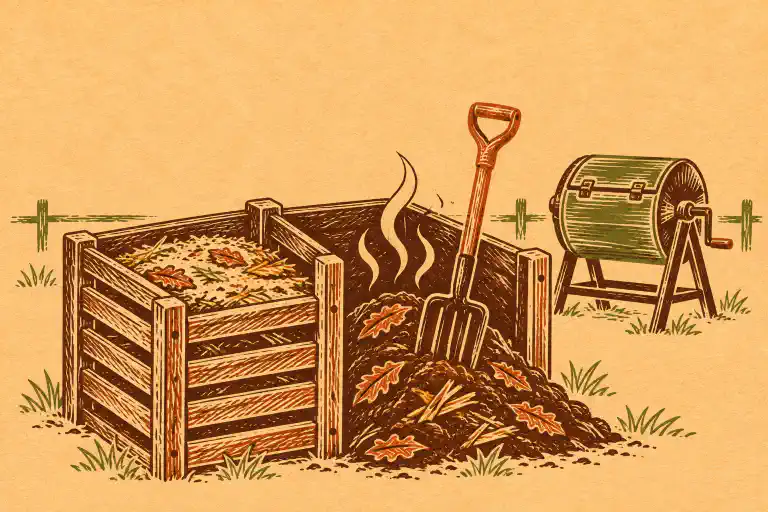
How often to turn compost depends on two things: whether your pile gets hot, and how soon you want compost. A small home bin that never feels warm has no schedule to keep. Turning speeds it up, and it’s the fix when the bin goes wet, dry or smelly.
Quick fix
- Small bin that never feels warm? You don’t need a schedule. Turn it more often if you want compost sooner (NC State Extension says weekly mixing speeds a backyard pile up), or when it’s wet, dry, smelly or packed down (When turning helps).
- Tumbler? Oklahoma State University Extension reports that turning a tumbler twice a week gave higher temperatures and faster decomposition than once a week. Loaded it in one go? University of Arkansas Extension says once a day. Wet, or rolling into balls? See Compost tumbler problems.
- Pile that heats up? Turn it when the middle starts to cool.
- Turned it and nothing changed? Compost bin not working? Start here.
How often should you turn compost?
A small bin that never warms up needs no schedule; turn it more often if you want compost sooner. A pile that heats up gets turned as its center cools. For the light-touch option, the UK’s Royal Horticultural Society (RHS) says: “If possible, turn your compost several times a year. This will speed up composting”.
| Your bin or pile | How often | Source |
|---|---|---|
| Small home bin or pile, no hurry | “No turning schedule. You can just pile material and let it sit.” | Oregon State University Extension, on slow composting |
| Any backyard pile, per UGA’s composter tips | “should be turned at least once a week” | UGA Extension’s Master Composter tips, for compost piles in general |
| Pile of only leaves | Whole leaves: “does not need turning”. To speed it up, “shred the leaves and turn the pile monthly” | Alabama Extension |
| Closed plastic cone (“dalek”) bin | In the parts we read, none of the sources we checked gives a schedule for a cone bin. Our advice: treat it like a small bin with no hurry: no schedule. | Scoped absence; our advice |
| Tumbler | “turning two times a week resulted in higher temperature and faster decomposition than turning once a week or once every other week” | Oklahoma State University Extension, from its Figure 1 comparison |
| Tumbler loaded in one go, nothing added after | “turn the tumbler once a day” | University of Arkansas Extension |
| Pile that heats up | “Turn the pile when the center begins to feel cool to the touch.” | NC State Extension |
If your pile gets hot, the home-composting sources agree that you turn it as it cools. They don’t agree on how often that is. Oklahoma State says a hot pile “should be turned every three to four days, or when the temperature drops below 104 F” (that’s 40°C). University of Minnesota Extension, writing about an active pile at 130°F to 160°F, says “As the center cools, turn the pile”, and “Do this once or twice a month.”
A hot pile has one more trigger, from a fact sheet written for compost operators. Cornell says turning “when temperatures exceed 140° F (60° C) can prevent” two problems: the pile sterilizing itself above 160°F (71°C), and the risk of fire. If yours is running that hot, see Can compost catch fire? Our inference: a bin that never warms up has no temperature trigger at all.
Can you turn compost too often?
For a home bin, no source we checked warns against it, in the parts we read. Our home-composting sources (Oregon State, NC State, UGA, Minnesota and the RHS) don’t say that turning a home pile too often cools it or dries it out, and none sets an upper limit. Cornell’s operator sheet notes that a pile loses heat “through aeration”, and that piles of high-nitrogen wastes such as summer grass clippings need “frequent turning … to both provide oxygen and release excess heat”, but it sets no too-often limit.
The one warning comes from farm-scale composting. Rodale Institute, writing about compost at certified organic operations, says “Turning too often can interrupt the heating-up process, causing temperatures to drop.” That’s commercial-scale hot composting, not a home bin or pile.
Do you need to turn compost?
No, not if speed doesn’t matter. It’s your effort against time.
Oregon State says a pile that isn’t getting hot “can still make good compost”, and that a cool pile “can take three to six months or longer, but it requires far less management.” The RHS agrees: “as long as the ingredients are well balanced and speed isn’t a priority, then composting will usually happen naturally.” It adds that “if you’re getting poor results, turning should improve things.”
NC State gives the cost of skipping it. “Mixing the pile once per week … will hasten the composting process,” it says, while “A pile that is not mixed may take three to four times longer to produce useful compost.” Its own example: “It takes one or two years to compost if you leave the pile alone, or several months if you aerate the pile weekly.” UGA’s composter tips go further: piles “should be turned at least once a week”.
Want to turn less? Oklahoma State lists five ways to cut back. Two of them: mix in enough coarse material such as straw to let air through an open pile, or push aeration tubes into the pile. It also says that once most of the material has broken down, “less frequent turning is adequate.” One catch with any cool pile: weed seeds survive it (why).
When turning helps
Even a bin with no schedule needs a turn when you see one of these.
- Wet or packed down. The RHS says turning “adds air”, and wet or compacted material composts “slower as less air is available”. For a pile that smells “like rancid butter, vinegar, or rotten eggs”, NC State’s fix is “Turn the pile; mix in leaves, straw, sawdust, or wood chips.” More in Compost too wet.
- Dry. Turning gives you, in the RHS’s words, “an opportunity to assess the moisture level”. Our advice: rewet it in layers as you turn, as Compost too dry explains.
- A thick layer of fresh greens on top. Our advice: mix it in when you turn, so it doesn’t mat down. Browns and greens has the balance.
- Ants or rodents. UGA says a lot of ants means “it’s likely that the pile is too dry and that you’re not turning it enough” (ants in the compost bin). For mice and rats, it says to “turn your pile more frequently and be sure to bury your food waste in the pile” (pests).
How to turn compost
First, the RHS suggests: “Consider wearing gloves and a dust mask when turning compost, to minimise the relatively rare health risks.”
Open pile or slatted bin. NC State turns a pile “with a digging fork or shovel”, “moving the material from the outside to the center”. A 4-tine spading fork such as the Truper 4-tine spading forkad does the job.
Closed cone bin. NC State’s fallback when you can’t turn a pile is to “poke it with an aerating device or broom handle”. Our advice: with the lid off, twist a corkscrew aerator, such as the Lotech Compost Crank Twistad, down into the pile and pull it out, or lift the whole bin off.
Tumbler. Spin it. The UK charity Garden Organic calls tumblers “an easy way to turn your heap regularly”, and says they’re “best treated as a batch process”.
If that didn’t work
- Turned it and it still looks like what went in? Compost bin not working? Start here.
- Small bin, never warm, and you want heat? Compost not heating up?
- Hot pile over 140°F (60°C), or steaming hard? Can compost catch fire?
- Bottom dark and crumbly? Is my compost ready?