How to make a compost bin: pallet, wire or wood, and how big
For a pile that heats, build at least 3 feet by 3 feet. Pallets or a wire ring need little skill; some wood plans take carpentry. Plus where to put it.
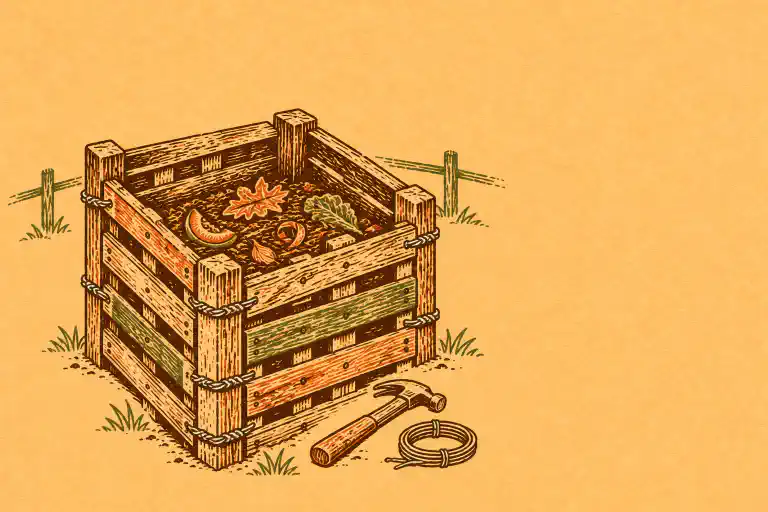
For a pile that holds its heat, Colorado State University (CSU) Extension says to build the bin at least 3 feet by 3 feet. Pallets or a wire ring take little skill; wood runs from relatively easy to carpentry. Then fill it with browns and greens.
What to make a compost bin out of: pallet, wire or wood
The three builds differ in skill, ease of turning and how fast they dry out.
| Pallet bin | Wire ring | Wood bin | |
|---|---|---|---|
| What the plan uses | Four pallets, at least 3 by 3 by 3 feet | CSU: 10 feet of hardware cloth makes a ring 3 feet across. University of Wisconsin (UW) Extension: 12½ feet of hardware cloth | University of Connecticut (UConn): 4 by 4 by 4 feet. UW: four 3-foot frames |
| Skill | Little or none | Little or none | Relatively easy (CSU’s 2x4s) to carpentry (Illinois) |
| Upside | Inexpensive and durable | Inexpensive, holds a large volume | Solid wood doesn’t dry out as fast as wire |
| Downside | Hard to turn unless the front comes off | May need a plastic cover or tarp to keep from drying out | Can be more expensive to buy or build |
UW’s pallet, wire mesh and wood-and-wire plans each hold eight to ten 30-gallon bags of yard materials (pallet, wire, wood and wire).
How to make a compost bin from pallets
You need four pallets. Used ones are often available from local businesses, manufacturers or landfills. UW’s steps:
- Level the ground where the bin will sit.
- Stand four pallets in a square at least 3 by 3 by 3 feet and connect them with hook-and-eye or bolt latches. You can also tie or wire them together.
- A fifth pallet as a base is optional. It lets in more air and steadies the bin, but it rots faster than the sides and makes the bottom harder to turn.
To turn the pile, UW has you unhook the sides, set the bin up next to the pile and move the material across. UF/IFAS Extension in Sarasota County suggests at least two bins: take the front off one and fork its contents into the other.
The sources we read don’t explain pallet stamps or how to tell whether a pallet was treated. What they say about wood is below.
How to make a wire compost bin
Use hardware cloth for a sturdy ring that holds its shape. Chicken wire is weaker and needs lots of poles to stay up.
The plans give different lengths. CSU says 10 feet makes a 3-foot-diameter bin and 19 feet a 6-foot one. UW’s plan uses 12½ feet of 36-inch-wide, ½-inch hardware cloth; a 36-inch by 20-foot roll of ½-inch hardware clothad is enough for one. Its steps:
- Cut the hardware cloth, snipping the ends close to a cross wire.
- File down the sharp edges so they clip together easily and don’t snag your hands. UW lists work gloves for the job.
- Bend it into a circle, overlap the ends, fasten them with clips or wire ties, and set the bin somewhere level.
- Stakes inside the ring are optional. They steady it but make it harder to move the bin and harvest the compost.
Because it’s exposed, a wire bin may need a plastic cover or a tarp to keep it from drying out (signs it’s too dry). To turn it, undo the ties, set the ring up next to the pile and fork the material back in.
Want square corners? UConn’s 3 by 3 by 3 feet wire bin is four 1x4 frames covered in hardware cloth, hinged together and latched.
How to make a wood compost bin
CSU’s simple version is alternating 2x4s, which let air into the pile and make a relatively easy bin to build. For a bin that comes apart, here is UW’s wood and wire composter, which needs above-average building skills:
- Cut each of four 12-foot 2x4s into four 3-foot pieces.
- Cut a lap joint, ¾ inch deep and 3½ inches wide, in each end. Glue and screw the pieces into four 3-foot-square frames, five screws to a joint.
- Cut ½-inch hardware cloth into four 3-foot squares, bend the edges back 1 inch, and staple one taut onto each frame.
- Hinge the frames in pairs with the wire on the inside, then latch the free ends together with hook-and-eye gate latches.
To turn the pile, you undo the latches, pull the sides apart and move the bin.
The cut lists for other plans are in the links:
- UConn’s 4 by 4 by 4 feet bin uses rough-cut pine boards, with front boards that slide out of a slot.
- Illinois Extension’s wood and wire bin has two front doors for harvesting and turning, a lid that doubles as a sifter, and a full mesh lining.
- Three bins: CSU describes a three-chamber bin, one for adding to, one decomposing, one ready to use. Illinois’s 3-bin plan needs at least 3 by 9 feet of yard, and the Missouri Department of Natural Resources has a similar plan.
The UW, Illinois and Missouri plans call for eye and ear protection (UW, Illinois, Missouri).
Which wood the plans use
The plans differ. UW lists “cedar or non-arsenic pressure-treated” 2x4s. Missouri uses treated 2x4s for the frame and cedar for the slats. UF/IFAS says a holding bin can be made from old pallets or scrap wood (untreated), though its own post-and-board plan lists pressure-treated lumber. None of the plans we read explains why it picks treated or untreated wood. NC State’s list of what should not go into compost piles includes “Pressure-treated lumber, pressed wood, plywood (contain toxic chemicals)”; that list is about what goes in the pile and doesn’t mention bin frames.
Compost bin size and where to put it
CSU’s 3 feet by 3 feet is the minimum to keep the heat up; over 5 feet high, the pile packs down, squeezes out air and slows. Shredded material packs easily, so a smaller bin makes it easier to get air in by turning; coarse, woody material does better in a larger bin. CSU gives no maximum width. For why that size heats up, see hot composting. If your bin stays cold, see compost not heating up.
For placement, Illinois Extension suggests:
- Somewhere with good air circulation.
- Not in direct contact with wooden structures, as this will cause decay.
- Partial shade if you can, though it isn’t a necessity.
- You may want it near the garden and a water source, and near the kitchen if you add scraps often.
- You may want to screen it from view and keep it away from where you entertain.
None of these bin plans gives a distance from the house. NC State Extension does: set a pile or bin more than 6 feet from your home or wooden structures, on flat ground protected from flooding or runoff to surface waters or wells. Unlike Illinois, its handbook puts compost downhill and as far as possible from the vegetable garden, for food safety.
Before you fill it
Start with browns and greens, the everyday mix by the bucket. To check a batch by weight instead, which is how the 30:1 target is measured, use the compost ratio calculator. For when turning is worth it, see how often to turn compost.