How to use compost in the garden, beds, pots and lawn
Mix finished compost into beds or spread it as mulch. Don't fill raised beds with compost alone, and mix it into soil for pots. It's low in fertilizer value.
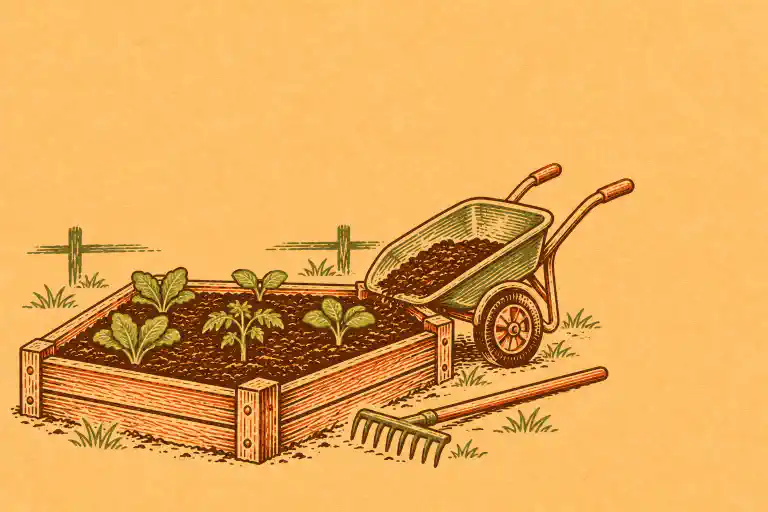
You can use finished compost in four main ways. Dig it into the top several inches of a garden bed, or spread a layer on top as mulch. Mix it with soil to fill a raised bed, or into potting soil for pots. On a lawn, spread a thin layer after aerating. Compost helps soil take in and hold water, but it’s a soil amendment with low fertilizer value (more below).
For beds and lawns, the compost calculator fills in Oregon State University (OSU) Extension’s depth and turns your bed or lawn size into bags or cubic yards. For mulch, type in a depth such as the US EPA’s 3 inches.
How to use compost, by use
Mix it into garden beds
To improve bed soil, the guides have you spread compost and mix it in. Their figures don’t match, and they cover different jobs:
- OSU Extension, for a new vegetable bed: 3 to 4 inches of compost, worked into the top 8 to 12 inches of soil.
- US EPA, for compost as a soil amendment, with no bed type named: 2 to 4 inches, mixed into the top 6 to 9 inches.
An established vegetable bed gets much less: a quarter inch to 1 inch a year. New landscape beds and new lawns have depths of their own, and the calculator has each.
Mix it in with a digging fork, spade or shovel; loosening the soil also lets more air in. A spading fork such as the Truper 4-tine spading forkad does the job. In clay soil, compost improves aeration and drainage; in sandy soil, it holds more water.
Spread it as mulch
You can also leave compost on the surface. Two guides give a mulch depth, and they differ a little:
- US EPA: loosen the top 2 to 3 inches of soil, then spread a 3-inch layer of compost, a few inches away from plant stems and tree trunks.
- UF/IFAS Extension (Sarasota County): 3 to 4 inches on the surface, not dug in, kept 2 to 3 inches away from plant stems.
On the surface, compost can conserve moisture, control weeds, reduce erosion, improve appearance, and keep the soil from gaining or losing heat too fast, says NC State. UF/IFAS disagrees on weeds: compost on its own won’t block them and can encourage them unless you cover it with a standard mulch. On a newly seeded lawn, a thin layer of compost as mulch keeps in the moisture seeds need to sprout; OSU gives no depth for it.
Compost that isn’t quite finished can go on top as mulch too: see using compost that’s not ready.
Raised beds and pots: can you plant directly in compost?
Raised beds: no. Don’t fill a raised bed with compost alone. Compost lacks the mineral part of soil, so it has to be mixed with soil or a planting mix to support plant growth. Two ways to fill one:
- With soil you dug out while building the bed: add up to 25% compost by volume.
- With a bulk mix from a landscape supplier: a common one is a three-way mix of equal parts topsoil, sand and compost.
Expect a newly filled bed to sink as the compost in the mix breaks down; top it up as needed.
Pots: mix it in, too. Every pot mix in these guides pairs compost with something else, so don’t plant in compost alone (that’s our reading, not a source’s rule). Clemson Extension’s soil-based potting mix is equal parts compost, topsoil and sand, written for South Carolina conditions. For indoor plants, mix compost with potting soil; it can also go in window boxes and container gardens. None of the guides we read gives a compost-to-potting-soil ratio, or an amount per pot.
Top-dress a lawn with compost
Top-dressing means spreading compost over an existing lawn:
- Mow the lawn short and collect the clippings.
- Run a core aerator over it, then break up the plugs with a rake.
- Spread compost a quarter to half an inch deep, so it fills the aeration holes.
- If you’re overseeding, spread the seed before or after the compost.
Late spring and early fall are the best times for this; new seed sprouts quickly once the soil is above 60°F.
Is compost a fertilizer?
Not really. Compost slowly releases and retains nutrients in the soil, but it’s a soil amendment rather than a fertilizer. Its fertilizer value is low compared with chemical salt fertilizers, and lawns, vegetables, and fruiting trees and shrubs often need more fertilizer to thrive.
Compost can reduce the need for fertilizers, but it’s often not enough to supply all plants’ needs, so have your soil tested and fertilize to match. For vegetable beds, OSU has you add amendments such as lime and N-P-K fertilizer as a soil test indicates. For how compost compares with fertilizer, mulch, topsoil and manure, see compost vs fertilizer.
Before you spread it: is it finished?
Good compost looks like dark topsoil, light and crumbly, and smells earthy. A foul, ammonia or sulfur smell means the composting isn’t complete. To make sure compost is fully mature and stable, test it on radish seeds: it shouldn’t keep them from sprouting or damage the plants. We’d run that check before compost goes near seedlings.
For the signs and a simple jar test, see how to tell when compost is ready.
Cautions
- Manure or mushroom compost. Compost made from these may have high soluble salts. The salts can harm vegetable seeds and transplants and lawn seed, and damage sensitive plants such as blueberries. Check what a store-bought compost is made from before you use it on these.
- Too much compost. Too much at once or over several years can keep plants from thriving and leach nutrients into surface water and groundwater; keep to the depth for your use.
- Herbicide residue. Store-bought compost and soil mix sometimes carry growth regulator herbicide residue, likely from hay, grass clippings or manure. Watch for distorted or cupped new leaves. Ask a bulk seller whether they test for it, though a basic lab test may not catch it. For your own pile, keep out herbicide-treated plants and grass.
- Weed seeds. Compost from a pile that never got hot may carry weed seeds. When buying bulk, ask whether it’s stored under tarps or otherwise protected from windblown weed seed. None of the guides we read says how many seeds finished compost may hold, or how to test for them.
- Food crops. Compost from a pile left alone needs care around edible crops: see this caution.
For beds, mulch or a lawn, work out how much you need with the compost calculator.