How long does compost take? How to tell when it's ready
Ready compost is dark, crumbly and earthy, with almost nothing recognizable left. A bin needs months: take it from the bottom, put the rest back.
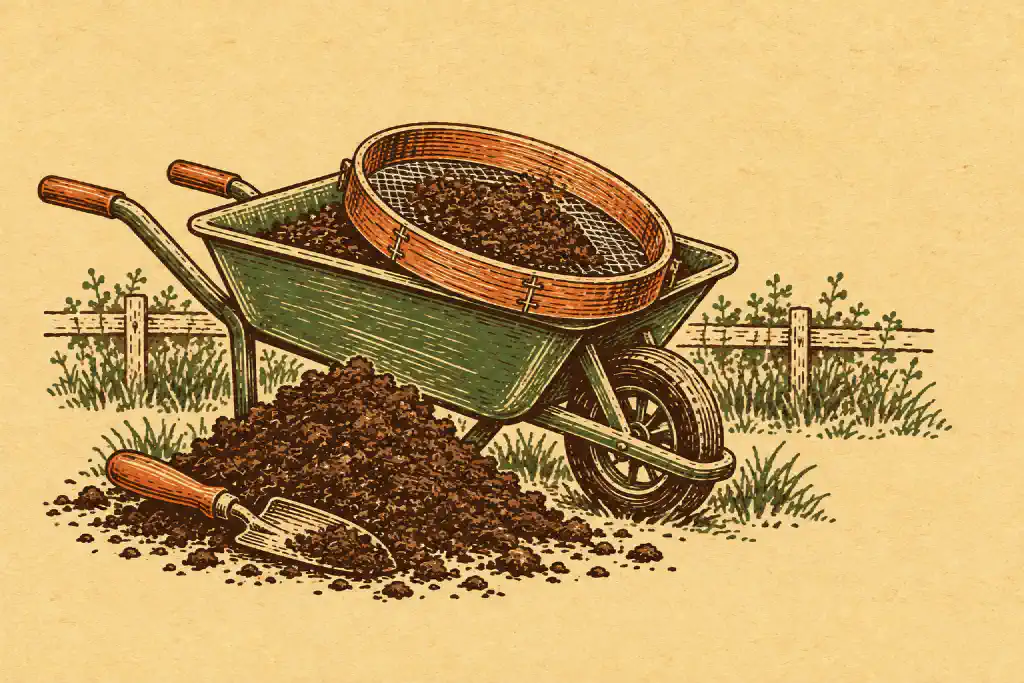
How do you tell if compost is ready? You’ve probably found timelines from a few weeks to a couple of years. Your bin isn’t the problem: the advice varies because bins, what goes in them and the seasons all differ. So the compost itself is a better guide than the calendar.
Quick fix
- Find the oldest compost. In a bin you keep adding to, that’s the bottom: use the hatch, or dig in low at the side of the pile. In a tumbler, tip a little out.
- Dark, crumbly, earthy-smelling and mostly unrecognizable? It’s ready: take it out. Planting soon? Run the jar test first.
- Not there yet?
- Part-rotted, and the level is sinking? It’s working. Use it as mulch, or give it months.
- Mid-winter and quiet? It’s probably just resting. See Composting through winter.
- Outside winter, the oldest layer still looks like what went in and the level isn’t dropping? It’s stalled. See Compost not breaking down (a plastic cone bin or tumbler has its own fixes).
What does compost look like when it’s ready?
The UK’s Royal Horticultural Society (RHS) says “Mature compost is dark brown, with a crumbly, soil-like texture and should smell like damp woodland.” UF/IFAS Extension lists two more signs: the pile “has shrunk significantly, up to one-half its original volume”, and the original materials “are no longer recognizable for what they were”.
A few eggshells or fruit pits in otherwise dark, crumbly compost are fine: it can still be ready.
If it’s still noticeably warm inside, it’s working. But coolness isn’t the test. A bin that never warmed up can be ready, because a cold bin still makes compost.
How to make sure: the jar test
If you’ll be planting soon, or the compost will touch roots, leaves or seeds, Cornell Cooperative Extension of Tompkins County suggests a one-week jar test. If you’re sowing seeds, Cornell’s leaflet also gives a germination test using radish or cress.
The jar test:
- Put a couple of inches of compost in a jar.
- Add water until it’s soggy, and seal the jar tightly.
- Leave it for a week.
- Open it carefully and smell it straight away.
Cornell says: “If it smells like nice wet earth, then the compost is done.” A bad smell, it says, means the compost hasn’t decomposed enough.
So that jar needs more time, not a fix: put the compost back and give it longer.
Take from the bottom, put the rest back
In a bin you keep adding to, the bottom finishes first. Scotland’s Aberdeen City Council, in its composting guide, says to “Check the compost at the bottom of the bin”, and that material from the top layers that hasn’t finished “can be put back in the bin.”
- Open pile or slatted bin: fork the unfinished top aside, dig out what’s ready, and pile the rest back.
- Bin with a hatch: take what’s ready through the hatch. To empty a closed plastic cone bin, lift the bin off.
- Tumbler: empty the finished batch, and put anything still recognizable back in.
To sieve compost for potting mix, UF/IFAS says you “may want to screen compost through a 1/2-inch screen to remove material that has not yet decomposed.” On top of garden beds, a few lumps are fine.
And the unfinished part isn’t wasted.
Can you use compost that’s not ready?
Yes: on top of the soil, or dug in during the fall. Scotland’s City of Edinburgh Council says unfinished compost, “where you can still recognise bits of what you originally put in, like eggshells, can be used as a layer of mulch on the soil surface.”
It adds that unfinished compost “can also be dug-in to condition garden soils in the autumn, so it finishes decomposing in the earth by spring.” The fall timing matters: it gives the compost the winter to finish before spring planting.
UF/IFAS Extension says “Using unfinished compost as a soil amendment may stress plants, causing them to yellow or stalling their growth.” So for a bed you’ll plant soon, keep unfinished compost on top. Compost from a bin that never got hot may also carry weed seeds.
Nothing usable yet? Then it’s down to time.
How long does compost take in a bin?
Expect months. The RHS says home compost “can take between six months and two years to reach maturity”, and that composting “tends to be faster in warm weather and slows down over winter.”
A closed plastic cone bin has its own slow-bin timeline. Tumbler owners: see how long a tumbler really takes.
If it isn’t ready yet
- Months on, outside winter, and the bottom still looks like what went in, with the level not dropping? Work through Compost not breaking down.
- Taken what’s ready, and only fresh scraps are left for winter? Expect a quiet spell: see Composting through winter.
- The bin smells sour, of rotten eggs or of ammonia when you dig? See Why your compost smells.
Got a wheelbarrow load? Start the next batch with the mix in Browns and greens.