Mold, fungus or mushrooms in the compost bin: what's normal
Mold in a compost bin is usually fungi doing their job. Leave white threads, check dry spots, bury moldy scraps and don't eat mushrooms.
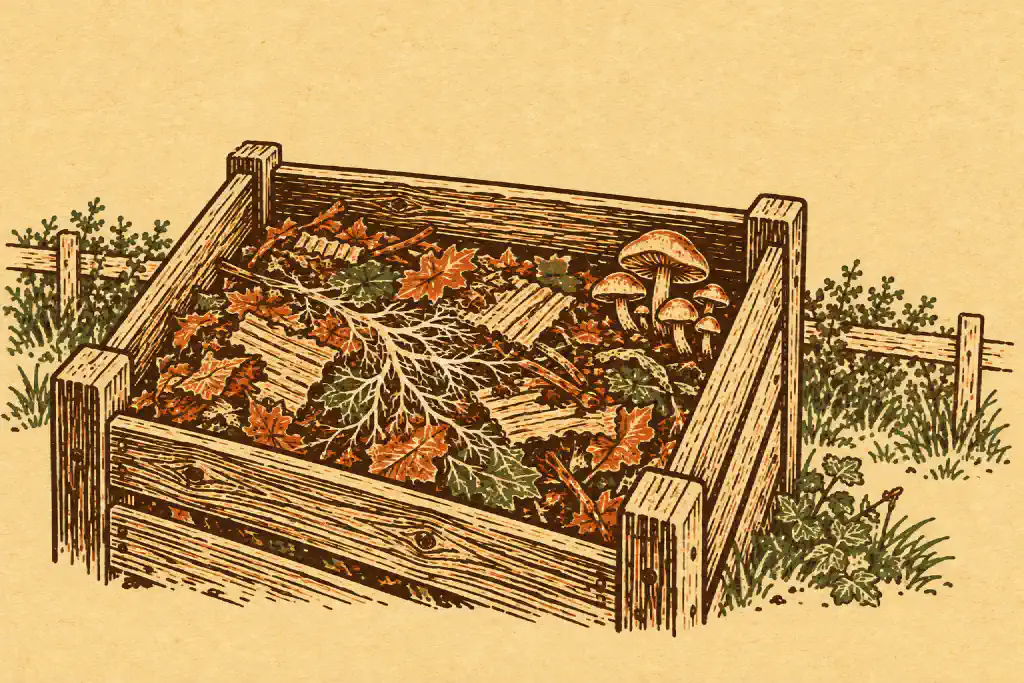
Finding mold in your compost bin doesn’t mean you’ve ruined it. White fuzz and threads are part of how leaves, cardboard and scraps break down, and mushrooms can turn up too. Two kinds of growth are worth a closer look: colored mold on fresh scraps on top, and white threads in a dry, dusty spot.
Quick fix
- White fuzz or threads on leaves, cardboard or wood chips? Leave them.
- Green, blue-gray or black mold on fresh scraps on top? Bury new scraps under 2–4 inches (5–10 cm) of browns and keep the lid on.
- Mushrooms? Leave them or pull them out, but don’t eat them.
- White threads in a dry, dusty spot? Do the squeeze test in step 2 below before you change anything.
Is mold in compost bad?
For the compost, usually not. Cornell’s composting guide says “Fungi include molds and yeasts”, and that in compost they “break down tough debris”. White or gray fuzz on leaves, cardboard or wood is the bin at work. Our advice: leave it alone. There’s no need to scrape it off, empty the bin or treat it. Mold on fresh scraps on top is the one to deal with (step 1).
Your health is a separate question. For anyone with a weakened immune system, the CDC lists steps to reduce the risk of aspergillosis, which it describes as an infection caused by Aspergillus, a common mold. Its advice includes: “Avoid activities involving close contact to soil or dust”, though the CDC notes these steps “haven’t been proven to prevent aspergillosis”. Our advice: if you have a lung condition or a weakened immune system, ask your doctor about handling compost.
What’s growing in your compost bin
Match what you see. Most rows need nothing from you.
| What you see | What it probably is | What to do |
|---|---|---|
| White fluffy fuzz or threads on leaves, wood chips or cardboard | Fungal threads (mycelium) or mold | Leave it |
| Gray threads like cobwebs, mostly in the outer 4–6 inches (10–15 cm) | Thread-forming bacteria (see below) | Leave it |
| Green, blue-gray or black fuzz on fresh scraps on top | Mold growing on the scraps | Step 1 below |
| White threads in a dry, dusty or crumbly spot | Fungal threads in a dry spot | Step 2 below |
| Mushrooms | Fungi fruiting | See below |
If the tiny white specks move, they’re creatures, not mold: see tiny white bugs in our guide to bugs in the compost bin.
White stuff in compost: fungal threads and gray cobwebs
The UK’s Royal Horticultural Society (RHS) calls the network of fungal threads mycelium. It says that occasionally, when conditions suit, mycelium grows enough to become visible “as a white, fungal-smelling growth” in soil or in a compost pile.
Gray cobwebs may be a different organism: actinomycetes, bacteria that grow in branching threads. Cornell says they break down tough material “such as woody stems, bark, or newspaper”, and that the threads are “most commonly seen toward the end of the composting process”.
Seeing them doesn’t mean the whole bin is ready, though. In a bin you keep adding to, the bottom finishes first, so start there: how to tell when compost is ready.
Mushrooms growing in the compost bin
Mushrooms are the fruiting bodies of fungi growing through the bin. The RHS lists compost piles among the places they can appear and says “The appearance of toadstools in a garden should not usually be a cause for concern.” It also warns that just because something is called a mushroom, “you should not assume that it is edible”.
Our advice: you can leave them, or pull them out if you’d rather not have them there. Either way, don’t eat anything that grows in a compost bin.
Moldy compost: the two cases worth fixing
- Bury moldy scraps with the rest. Pull back the top layer, add the new scraps, then cover the new and moldy scraps together with browns, such as dry leaves, shredded cardboard or straw. Our advice: there’s no need to pick moldy scraps out first. In a tumbler, mix new scraps in with browns rather than leaving them on top, then turn it.
- Check a dry spot with the squeeze test. Squeeze a handful from the middle of the bin, not the dry spot. If the middle holds together like a wrung-out sponge, the bin is fine: leave the spot alone. If it crumbles and won’t hold its shape, the whole bin is too dry. Break it apart with a fork and water each layer as you go, rather than pouring water on top, until a squeezed handful holds together without dripping. Compost too dry has the full method.
Fungal threads in a dry spot are no surprise: fungi cope with dry material better than bacteria do. Cornell says fungi can attack organic residues that are “too dry, acidic, or low in nitrogen for bacterial decomposition”.
If that didn’t work
Still not sure, or ready for the next step?
- Still crumbly after rewetting? Work through Compost too dry.
- Tiny white specks that jump or crawl? See tiny white bugs in the bugs guide.
- Bottom of the bin dark and crumbly? Check how to tell when compost is ready.
- Scraps under the mold slimy, or a bad smell? Try Can slimy compost be saved? or why your compost smells.