Can you compost paper towels, egg cartons, cardboard and shredded paper?
Paper towels, egg cartons, cardboard and shredded paper: yes, as browns, unless greasy, glossy, waxed or chemical-soaked. Receipts and used tissues stay out.
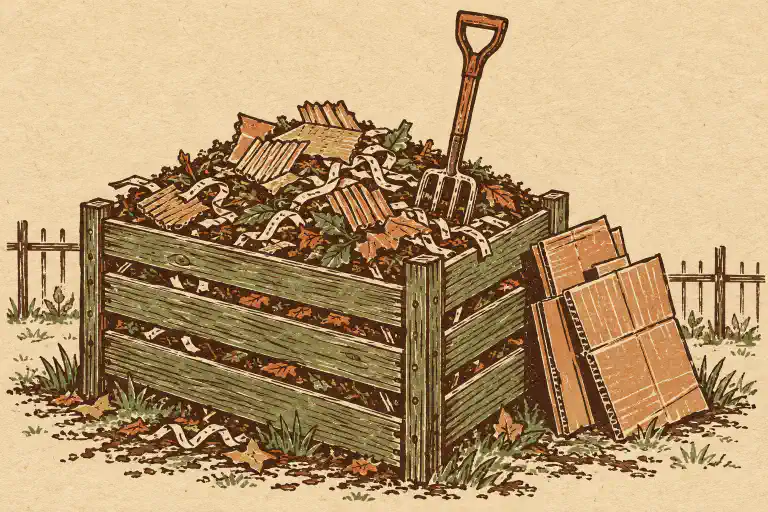
A recycling bin full of boxes looks like the answer to a compost bin short on browns, and mostly it is: shredded paper and cardboard are browns, the dry carbon that balances kitchen scraps. The trouble is the exceptions, where guides disagree or skip the reason.
Quick fix
- Plain cardboard, newspaper, paper towels or egg cartons? Take off the tape, tear or shred them, and mix them in.
- Glossy, waxed or plastic-lined paper, or receipts? Leave them out (the list).
- Greasy pizza box? Tear off the greasy part, or leave the box out (pizza boxes and PFAS).
- How much? Two to three buckets of browns per bucket of scraps, paper a small share (step 5).
- Paper matted, or cardboard still whole? See the fixes.
Can you compost it? Paper and cardboard, item by item
Most of it is a yes. Most of the noes share a cause: a coating or grease.
| Paper or cardboard | Compost it? | Why |
|---|---|---|
| Plain cardboard and corrugated boxes | Yes, torn or shredded | The EPA lists “Shredded cardboard (no wax coating, tape, or glue)” as a brown. |
| Newspaper and paper bags | Yes (black-and-white pages) | Both are on NC State Extension’s list. UMN Extension lists “Shredded newspaper (black and white print)”; for color sections, see the colored-paper split (below). |
| Office paper, junk mail, cereal boxes | Your call | NC State lists all three, but the sources split on office and colored paper (below). |
| Paper towels and napkins | Yes, unless greasy or chemical-soaked | The Wisconsin DNR lists “Paper towels”; NC State lists “Paper napkins” and “Soiled paper.” Exceptions: see below. |
| Used tissues | No | NC State: “Used facial or toilet tissue (may contain pathogens).” |
| Paper egg cartons | Yes, shredded | Wisconsin DNR: “Egg cartons (shredded).” More below. |
| Paper plates and bowls | Your call (PFAS) | NC State lists “Paper plates,” but EPA’s PFAS report names plates and bowls (below). |
| Pizza boxes | Clean parts only | See below. |
| Glossy paper, magazines, catalogs | No | Glossy paper is on EPA’s avoid list. See what not to add. |
| Waxed cardboard, paper cups, cartons | No | EPA rules out wax coating; Wisconsin DNR keeps “Coffee or beverage cups” out. The home-composting guides we checked don’t name cartons; Lino Lakes’ commercial drop-off refuses milk cartons and juice boxes as “Papers with a plastic lining.” |
| Receipts (thermal paper) | No | See below. |
| Tape, shipping labels, staples | Take them off | EPA’s cardboard entry says no tape or glue. The sources we checked don’t mention shipping labels, or staples in boxes (EPA names staples only on tea bags); our advice is to pull them too. |
Can you compost paper towels?
Yes, unless they’re greasy or have chemicals on them. The Wisconsin DNR lists “Paper towels” among its browns, and NC State lists “Paper napkins” and “Soiled paper.” Used tissues are different: NC State keeps “Used facial or toilet tissue (may contain pathogens)” out.
Our advice on towels: throw out ones soaked in grease or with cleaning chemicals on them. EPA keeps “Fats, oils, and grease” out of backyard piles. The organics drop-off in Lino Lakes, Minnesota, which feeds a commercial compost site, refuses towels “with chemicals on them” but accepts natural cleaners such as vinegar.
Can you compost egg cartons?
Yes, paper ones, shredded. The Wisconsin DNR lists “Egg cartons (shredded)” among its browns, and NC State lists “Paper egg cartons” among things that may go in a home bin. Tear or shred them like cardboard, and mix them in. None of the sources we checked tested egg cartons for PFAS (below).
Colored and office paper, and printer ink
The sources disagree, and we’d treat printed boxes and mail the same way. EPA’s brown is shredded paper that’s “non-glossy, uncolored,” and UMN Extension Master Gardeners say “Colored and glossy paper tend to contain heavy metals and should not be used.” Jeff Schalau of University of Arizona Cooperative Extension wrote in 2014 that colored paper “may be used without significant risk,” but, citing an unnamed “science-based source,” that office and glossy paper “may contain dioxins”: with bleached and glossy paper, “it would be wise not to use them in the garden.”
On ink, the Master Gardeners say most printing inks are vegetable-based, and suggest checking the printer cartridge box label and your employer’s permission before taking shredded documents home. None of the sources we checked covers laser toner.
Pizza boxes, greasy paper and PFAS
Grease is the reason to tear a pizza box apart. NC State lists “Pizza boxes,” but Wisconsin DNR keeps out “Pizza boxes with grease or cheese on them,” and EPA keeps grease out of backyard piles, partly because it can attract animals. Our advice: compost the clean lid and throw out the greasy base, or leave the whole box out.
PFAS are the other worry. If you’d rather avoid the question, leave out food-contact paper of the kinds EPA names, such as paper plates and bowls, microwave popcorn bags, fast-food wrappers and paperboards.
- Where PFAS turn up: A 2021 EPA report says they are “often used in food contact materials due to their resistance to grease, heat, oil, and water,” and names those papers among the items shown to contain elevated fluorine or specific PFAS.
- What has changed: On February 28, 2024, the FDA announced that grease-proofing substances containing PFAS “are no longer being sold by manufacturers for food contact use in the U.S. market.” The update covers paper and paperboard food packaging and describes a voluntary phase-out. It doesn’t say whether older stock or any particular box contains PFAS.
- What’s unknown: On the risks of spreading compost made from PFAS-contaminated food waste on land, EPA says general conclusions “cannot be made with confidence.” None of the sources we checked tested pizza boxes, shipping boxes, newspaper, egg cartons or paper towels for PFAS, or tested paper on its own in a home bin. (EPA’s one backyard sample mixed food waste, yard trimmings and unbleached coffee filters.)
Receipts: leave them out
The Minnesota Pollution Control Agency says receipts “are generally printed on thermal paper coated with either Bisphenol-A (BPA) or its chemical cousin Bisphenol-S (BPS),” and adds: “We recommend you do not put thermal receipt paper in your recycling or compost bin.” Thermal paper, the agency says, is “thin with a slick feel or sheen finish” and “discolors easily when scratched with a coin or paperclip.”
How to add shredded paper and cardboard so it rots
Paper is low in nitrogen, “which decreases the decomposition rate,” NC State says, so make it small, damp and mixed.
- Strip it. Pull off tape, plastic windows, labels and staples.
- Tear or shred it. Smaller pieces break down faster, EPA says. Flatten boxes and tear them into hand-sized pieces.
- Wet it. EPA says the mix should have “the consistency of a wrung-out sponge.” In practice, a squeezed handful holds together without dripping.
- Mix it in. EPA and NC State describe building in layers, but paper shouldn’t form one alone. NC State also offers mixing browns and greens as you load, and warns that “very fine particles will prevent air from flowing into your compost pile.” Our advice: in a tumbler, add paper a little at a time and spin.
- Keep paper to a share. This site’s rule of thumb is two to three buckets of browns per bucket of greens, by volume. NC State says paper “should make up no more than 10% of the total weight of the material in the compost pile,” and “It is better to recycle paper curbside or take it to a community collection site.”
Because of that cap, make leaves, straw or wood chips most of your browns. Our advice: if boxes are all you have, use them sparingly and find other browns on the browns and greens list. To check a weighed mix against a 30:1 carbon-to-nitrogen ratio, use the compost ratio calculator.
Shredded paper matted into a layer
A gray, pressed sheet of paper, dry on top or soggy underneath, usually means paper went in thick and alone. Fine pieces pack tight, and the UK’s Royal Horticultural Society says compacted material composts more slowly “as less air is available.”
Break the mat up with a garden fork, such as the Truper 4-tine spading forkad, and mix it through with greens. Then squeeze a handful. If it falls apart dry, water as you turn (Compost too dry). If it drips, treat it as a wet bin (Compost too wet).
Cardboard still in one piece months later
If it’s waxed, take it out (see the table). Otherwise, whole sheets are usually too big, too dry or too short of greens; Clemson Extension lists all three among the causes of slow decomposition. The sources we checked give no time for cardboard in a home bin. Tear what’s left smaller, wet it and mix in greens. For other stalls, see Compost not breaking down.
If that didn’t work
- Smells sour or of ammonia? See Why your compost smells.
- Paper clumping in a tumbler? See Compost tumbler problems.
- Not sure about something else? See What not to add, or Can I compost it? for eggshells, sawdust, bread and other gray-area scraps.