How to speed up composting: what works, and whether you need an activator
Chop it smaller, keep it damp, add greens, build it big enough and turn it. Extension guides say compost activators and starters aren't needed. Check your mix.
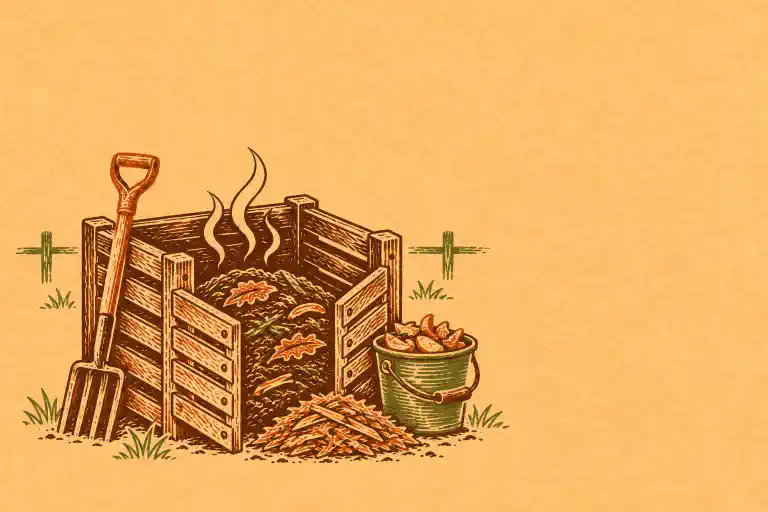
To speed up composting, chop what goes in smaller, keep the pile as damp as a wrung-out sponge, add enough greens for nitrogen, build it big enough to hold heat, and turn it to let air in. Slow compost often comes down to four of those: dryness, too little nitrogen, too little turning and pieces that are too big. You don’t need a bought activator to make compost faster (why). If it might be the mix, the calculator below checks it with your own weights.
Quick fix
In our order, biggest payoff first:
- Big pieces going in? Chop them to under about 2 inches.
- A handful from the middle feels dry? Wet it to a wrung-out sponge.
- Mostly leaves, cardboard or straw? Add greens, and check the mix.
- Small bin? It will be slower, and that isn’t a fault: what helps.
- Never turned it, or it’s packed tight? Turning lets air in and speeds it up.
Chop it smaller
Decomposition happens on the surface of each piece, so smaller pieces break down faster. Aim for under about 2 inches, but not dust: very fine material keeps air from flowing through the pile. Run a lawn mower over fall leaves with the bag on, chop soft material in a bucket with a square-end shovel, and shred or chip branches thicker than 1 inch (fall leaves have their own guide).
The cost is more turning: a pile of mostly small pieces needs turning more often.
Keep it damp
When a pile’s moisture is off, it’s most often too dry, and that slows it down. In any bin or tumbler, squeeze a handful from the middle. A drop or two of water means it’s right; none means it’s too dry. If a stream of water runs out, it’s too wet, which slows it too.
Add water as you turn a dry pile, and cover an open one to hold the moisture in. The full fixes are in Compost too dry and Compost too wet.
Add greens: check your mix
A pile of mostly browns, such as leaves, cardboard or straw, is short of nitrogen, and with too little nitrogen, composting is slow. This site’s everyday rule is 2 to 3 buckets of browns to 1 of greens, by volume (what counts as each).
The calculator checks a mix by weight, a different scale from the bucket rule (why). It’s set to a leaf-heavy load, 10 lb of leaves to 2 lb of kitchen scraps, which reads browns-heavy. Change the materials and weights (in pounds) to yours. Weigh them on a kitchen scale such as the Etekcity 22 lb kitchen scalead, or make a fair guess.
What the result tells you to change:
- Browns-heavy: add greens first, such as kitchen scraps, or grass clippings mixed in with the leaves so they don’t pack down.
- Greens-heavy: add a brown. If the pile also smells of ammonia, see why it smells.
- About right: the mix is in range, so look at moisture, size and turning.
- Reads dry: see Keep it damp.
- Reads wet: see Compost too wet.
The calculator page explains each verdict in full.
For a pile of almost all browns, the sources’ fallback is nitrogen fertilizer. Iowa State suggests a high-nitrogen one “that does not contain herbicides” (so, in our reading, not a weed-and-feed), and it counts composted manure from poultry, rabbits, cows or horses as a stand-in. Iowa State adds the fertilizer in thin layers as the pile is built and works out the amount from the nitrogen percentage on the bag, not the lawn rate on the label. Virginia Tech prefers organic sources such as manure or blood meal, and generally doesn’t recommend urea for a pile of leaves alone. Never add dog or cat waste.
Build it big enough
Size lets the middle of a pile hold heat: 3 to 5 feet on each side (27 to 125 cubic feet) is enough for the center to heat up. A smaller bin still works. If you have only a little material, mix it with a bit of soil, finished compost, manure or fertilizer and form it into a pile: decomposition may be somewhat slower, but it still makes usable compost.
Chopping, moisture and greens help in any bin. To help a small one heat, increase its size by adding more in one go (Compost not heating up?, or build a hot pile). Another option is two piles, one finished and ready for the garden, one unfinished. Our advice: add new material only to the unfinished one. None of the sources we read measures how much faster any of this makes a small bin.
Turn it, or don’t
A pile doesn’t have to be turned, but turning speeds decomposition. For the fastest compost, turn it about once a week; for most home gardeners, every two to four weeks is enough. How you turn depends on the bin: see How often to turn compost.
Do you need a thermometer?
Not to compost successfully, though a long-stemmed one measures the heat at the center and helps you decide when to turn. For a number, push one, such as the Reotemp 20-inch compost thermometerad, into the middle. Without one, put on gloves, reach 8 to 12 inches in and feel whether it’s warm or hot. Iowa State says to avoid going above 170°F; if yours is steaming hard, see Can compost catch fire? A bin that never heats up still makes compost, more slowly: the slow route.
Do compost activators work?
You don’t need one. Compost activators, accelerators and starters are sold as a source of microbes, nitrogen or both, and the microbes that do the work already come in on your plant scraps. Iowa State, the University of Idaho and Washington State all say you don’t have to add an activator, starter or inoculant. Virginia Tech notes there’s no scientific evidence that inoculants make composting more efficient. Penn State Cooperative Extension of Montgomery County’s composting FAQ doesn’t recommend them, and calls accelerators a quick fix of nitrogen that doesn’t last and can wash out into surface and ground water.
The other side: Kansas State’s activator sheet uses the word for a nitrogen source, such as blood meal or manure, added to a pile of mostly browns. It calls a bought microbe activator unnecessary if you add garden soil, and says to follow the label if you’d rather buy one. NC State’s handbook lists small amounts of meals dusted on the greens, or water with molasses, sugar or flat soda, as ways to help a pile get hot.
What does help is nitrogen, which many activators contain: to see whether your pile is short of it, check your mix.
What you can skip
- Lime. Iowa State says it gives no benefit and can interfere; the Montgomery County FAQ warns it may cause nitrogen to be lost as ammonia gas. Idaho is milder: rarely helpful, though moderate use won’t hurt.
- Wood ash. Rarely helpful too, says Idaho, though moderate use won’t hurt: wood ash in compost.
- Worms. No: a pile should be too hot for them, and earthworms move in on their own once it cools.
- Layering. Iowa State and NC State give layers, with mixing as the other option; Washington State prefers mixing. Our view: the five levers above matter more.
Fast composting vs. the slow route that still works
Fast composting means pulling all five levers at once, which takes extra effort.
The slow route works too. When a pile isn’t kept hot, microorganisms still break the wastes down, more slowly, and slow composting is often the best method for people without time to tend a hot pile. The catch: few home piles get hot enough (above 145°F, and turned regularly) to kill weed seeds and diseased plants, so keep those out (more).
How long? Iowa State says a well-managed pile can produce finished compost in as little as two to four months, and one that isn’t regularly turned or maintained may take a year or longer. To check yours, see Is my compost ready?
If that didn’t work
- Tried all five, and it still looks like what went in? Compost bin not working? Start here.
- Tumbler? Compost tumbler problems.
- Midwinter? A cold bin is resting: Composting through winter.
- Bottom dark and crumbly? Is my compost ready?