Compost too dry: nothing is happening
A dry, stalled compost pile needs rewetting in layers as you turn, some shade, and enough bulk. Here's how to restart it.
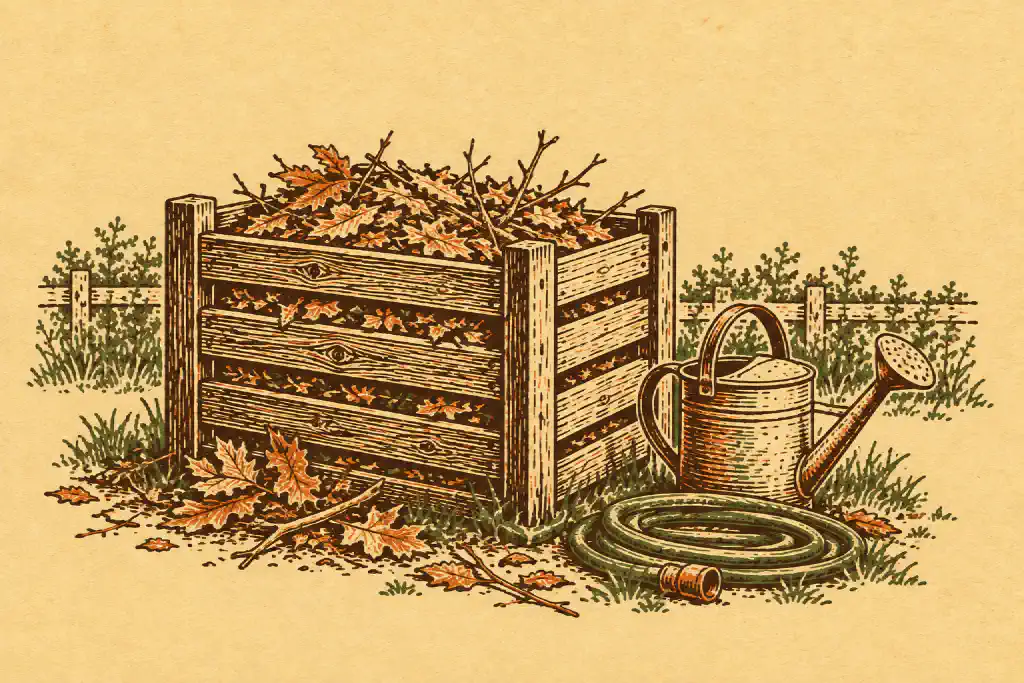
Decomposition is done by living organisms — bacteria, fungi, worms, insects — and like most living things, they need water. When a pile dries out, they slow down or go dormant, and the pile just sits there, week after week, looking exactly as it did when you built it. It’s a frequent reason a compost pile “stops working.” Not sure dryness is the problem? Match what you see inside the bin first.
Quick fix
- Do the squeeze test: grab a handful from the middle, squeeze. If it crumbles apart and doesn’t hold its shape, it’s too dry.
- Rewet gradually, in layers, as you turn the pile — don’t just pour water on top and walk away.
- Check the pile is big enough, roughly 3 feet (1 meter) each way, and consider moving it into shade.
Why decomposition stops
The organisms doing the work live in the film of moisture around every particle of material. When that film disappears, they can’t move, can’t feed, and effectively pause. A bone-dry pile can sit for months without changing: through summer heat, through a long dry spell, or simply because it was built mostly from dry, woody material with nothing moist mixed in.
The squeeze test tells you where you stand. Grab a handful from a few inches into the pile and squeeze it in your fist. If it crumbles apart, holds no shape, and carries no dampness you can feel, it’s too dry. You’re aiming for a wrung-out sponge: damp enough to clump loosely, dry enough that no water comes out.
Rewetting properly
The mistake most people make is watering a dry pile the way they’d water a dry potted plant: pour water on top and expect it to soak through. Compost doesn’t work like that. A dry pile, especially one heavy on straw, leaves, or cardboard, sheds water off the top rather than absorbing it, so the water runs off the sides while the core stays dry.
Instead, rewet as you turn. Break the pile apart with a fork and water each layer as you go, working moisture into the material rather than leaving it on the surface. Add water gradually and keep rechecking with the squeeze test — it’s far easier to add more than to rescue a pile you’ve suddenly made too wet. The same goes for a barrel or tumbler-style bin: open it up and turn the contents rather than tipping water through the top.
Sizing and shade
A small pile dries out fast. There’s more surface exposed to sun and wind, and less material inside to hold moisture and heat. Aim for something around 3 feet (1 meter) each way — about waist height and as wide — which gives enough mass to keep the center damp and warm. If your pile is smaller than that, build it up if you have room, or accept that it will need more frequent attention. Most plastic bins and tumblers hold less than this, so expect them to need checking and rewetting more often. A lidded plastic cone bin (a “dalek” in the UK) gets almost no rain, so it dries out in its own way: see Plastic cone compost bin not working?.
Location matters too. A pile in full sun all day, especially through a hot summer, dries out much faster than one in dappled shade, so give a new pile some shelter from the harshest part of the day if you can. For an existing pile you can’t move, a loose cover — enough to cut direct sun without sealing out air — helps it hold moisture longer between waterings.
After rewetting
Give it a few days after rewetting and turning before you expect real change. You may notice the center warming as the organisms wake back up, but many home bins never feel warm and still make compost: look for the pile shrinking and darkening instead. Once the bottom is dark and crumbly, Is my compost ready? shows how to tell it’s finished. No change at all after a week of consistent moisture? Check the greens. A pile that’s all dry browns has little for the organisms to feed on, however wet you make it.