Compost too wet: soggy, slimy, or dripping
A slimy, dripping compost pile can be saved: it needs more browns, more air, and a cover. How to dry it out, step by step.
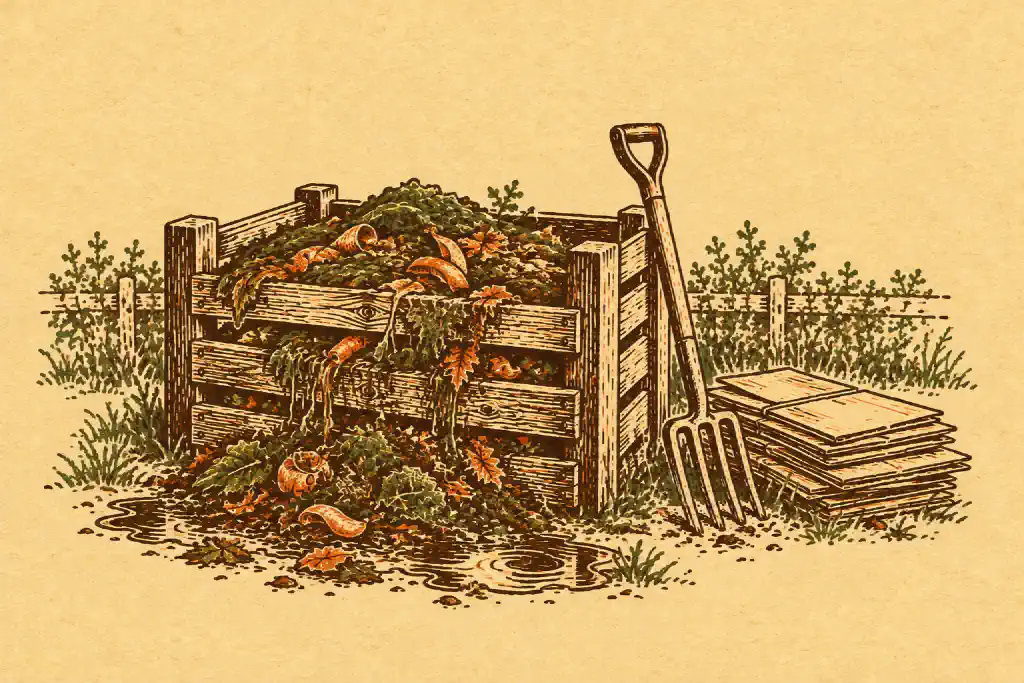
A compost pile needs to be damp like a wrung-out sponge, not wet like a swamp. Past that point the material clumps together, air can’t get through, and everything slows to a crawl or starts to smell. Here’s how to tell whether that’s what’s happening, and how to bring the pile back.
Quick fix
- Grab a handful from the middle of the pile and squeeze. If water runs out between your fingers, it’s too wet.
- Mix in dry browns — cardboard, dry leaves, straw — a bucket or two at a time, until the material holds together but doesn’t drip.
- Turn the pile to open it up, and put a cover over it if it isn’t already covered.
The squeeze test
Checking by hand beats checking by eye. Take a handful from a few inches down, not just the surface, and squeeze it in your fist. You want the feel of a sponge that’s been wrung out: damp enough to hold its shape, not so wet that water drips. More than a drop or two, or material that feels slimy rather than crumbly, means it’s too wet.
What causes it
Rain is a common cause, especially for an open pile with no cover. Heavy or prolonged rain can saturate a pile faster than it can drain, particularly once the pile has compacted. Grass clippings are another frequent culprit: they hold a lot of water, and added in one thick pile they mat down into dense, airless layers. Sometimes it’s simply too many wet greens — kitchen scraps, clippings — and not enough dry browns to balance them, which is the same imbalance behind most bad smells.
Poor drainage makes all of this worse. If your pile sits on packed soil, concrete, or anything else water can’t pass through, moisture has nowhere to go and pools at the bottom.
The fix, step by step
Start with dry browns: torn cardboard, dry fall leaves, straw, or shredded paper (avoid glossy paper). Mix them in throughout the pile rather than laying them over the top, because a dry crust does nothing for the wet mass underneath. Keep going until the mix feels closer to two or three parts browns to one part greens by volume — you can always add more if it still holds water.
Turning matters as much as adding dry material. Breaking up compacted, waterlogged clumps lets air back in, helps excess moisture evaporate, and gets decomposition moving properly again. Short of spare browns? Turning alone, done every few days, will dry the pile gradually just from exposure to air. In a closed bin that’s hard to turn, work a fork or aerator down through the top instead. If it’s a closed plastic cone (“dalek”) bin with a sticky lump at the bottom, see Plastic cone compost bin not working?.
Cover the pile if it isn’t covered already. A tarp, a sheet of cardboard, or a bin lid keeps rain from adding to the problem while you work on drying it out. You’re not sealing it airtight, just keeping direct rain off. (In a tumbler, skip the cover and the pallet below: leave the lid or vents open for a day instead, and see compost tumbler problems.)
If drainage underneath is the issue, raise the pile off the ground slightly. A wooden pallet, some branches, or a layer of coarse twiggy material at the base lets excess water drain away instead of collecting.
Can slimy compost be saved?
Yes. Slime means the pile is wet and airless, not that the material is ruined. Thick layers of grass clippings are a common cause: on their own, the UK’s Royal Horticultural Society (RHS) says, they “can become a slimy, smelly mess”. The fix is the one above, and Scotland’s City of Edinburgh Council puts it in one line: “Turn the heap and add more dry or woody materials, such as fallen leaves or small pieces of cardboard.” Break up the slimy clumps as you mix, so the browns reach the middle of them. In a tumbler, add the browns, turn it, and leave the lid or vents open for a day (more on tumblers). If it smells too, match the smell to its fix.
How long it takes
Don’t expect an instant fix. A properly waterlogged pile can take a week or more of added browns and regular turning before a squeezed handful feels like that wrung-out sponge again. Keep checking every few days, and hold off on adding more wet greens until it’s back in balance. If rain is the recurring cause, a permanent cover will save you from doing all of this again every time the weather turns. Once it’s back in balance, Is my compost ready? shows how to tell when it’s done.