Why your compost smells (and the fix for each smell)
Ammonia means too much nitrogen. Rotten eggs, sour, vinegar or poop mean too wet and airless. Rotting garbage means the wrong scraps. Match your smell to its fix.
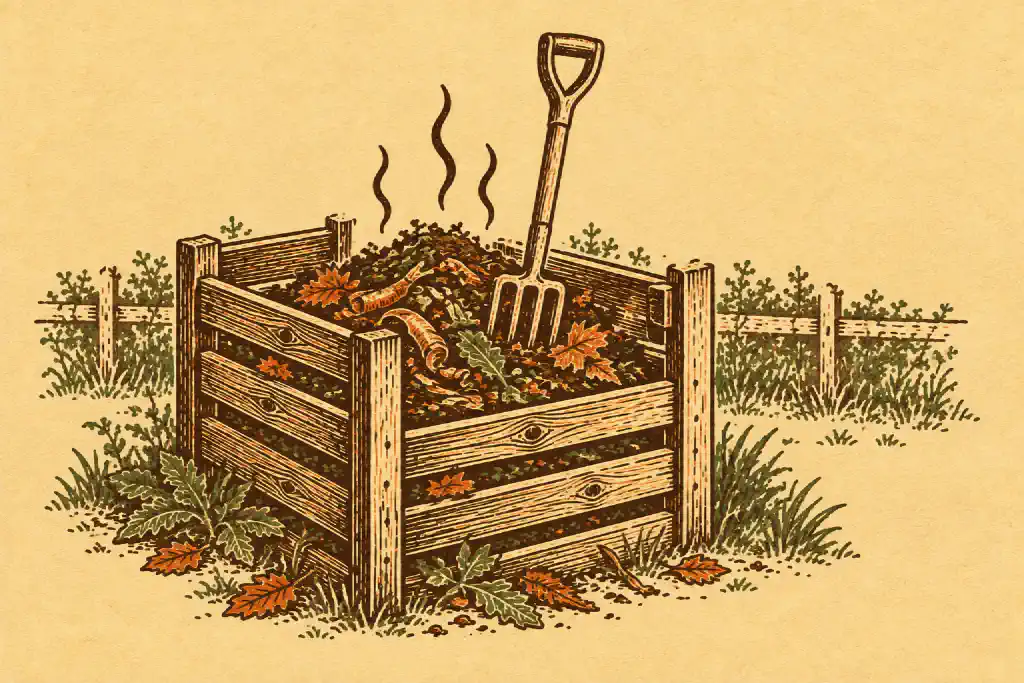
If your pile smells bad, the smell itself is the diagnosis. You don’t need to guess. Get your nose near the pile (not right in it) and work out which of the smells below you’re getting.
Quick fix
- Sharp, ammonia smell → mix in dry browns (cardboard, dry leaves, straw): at least a bucket for every bucket of fresh scraps you’ve added recently, working toward two or three.
- Rotten-egg, sour, vinegar or poop smell → turn the pile to get air into the middle, and cover it so rain stops getting in.
- Rotting-garbage smell → pick out any meat, fish, bones or cooked food, and bury the rest of the scraps.
- Either way, stop adding fresh kitchen scraps for a few days and let it settle.
The ammonia smell: too much nitrogen
If the smell is sharp and stings your nose, like the smell of a cat litter box, you’ve got too many greens relative to browns. Greens are the wet, nitrogen-rich stuff: grass clippings, fresh kitchen scraps, coffee grounds. When there’s too much of that and not enough dry, carbon-rich material to balance it, the surplus nitrogen breaks down into ammonia gas. That sting in your nose is fertility escaping — nitrogen that should have stayed in the pile to feed your plants.
The fix is browns. Torn-up cardboard, dry fall leaves, straw, and shredded paper all work; as a rough guide, add two to three buckets of browns for every bucket of fresh greens. Mix them in rather than laying them on top, because the smell is coming from inside the pile, not off the surface. And if the trigger was a big dump of grass clippings — a common one — spread future clippings in thin layers. A thick wet mat of grass turns slimy and airless almost immediately.
The rotten-egg smell: not enough air
A sour, sulfurous smell, like rotten eggs or a stagnant pond, means the pile has gone anaerobic. That’s compost-speak for “no oxygen is reaching the middle.” The organisms that break material down properly need air to breathe. Starve them of it and a different set takes over, one that gives off sulfurous gases as it works.
Two things cause this, usually together: too much water and too little structure. When a pile compacts, or sits uncovered through a stretch of rain, the gaps between materials fill with water instead of air. Break it open with a fork and let air back in, and the smell should ease once air is back in the middle. In a closed bin, work a fork or aerator down through the top; in a tumbler, give it a few turns. Turning weekly, or at least whenever you add a big batch of material, keeps it from coming back.
Rain is often the hidden cause. An open, uncovered pile soaks it up like a sponge. A tarp, a sheet of cardboard, or a bin lid stops the top layer becoming a soggy cap that seals air out of everything underneath. You don’t want it airtight, since the pile needs airflow; just keep direct rain off.
Sour, vinegar or alcohol smell
This is the same airless problem as rotten eggs, at an earlier or milder stage. New Jersey’s environment department, writing for compost sites, lists what an airless pile gives off: “volatile organic acids (which have vinegar, cheesy, goaty, and sour odors), alcohols and esters (fruity, floral, alcohol-like)”, while a pile with air should give “only a mild earthy odor”. Scotland’s City of Edinburgh Council puts the cause plainly: if a pile is too damp, microbes “which do not need air” take over and “tend to create smelly substances”. A thick layer of grass clippings is a common trigger; on their own, the UK’s Royal Horticultural Society (RHS) warns, they “can become a slimy, smelly mess”.
The fix is the one Edinburgh gives: “Turn the heap and add more dry or woody materials, such as fallen leaves or small pieces of cardboard.” If it’s very wet, the too-wet guide has the rest.
Poop, sewage or manure smell
Two possible causes. The first is, again, no air: the same New Jersey list includes “barnyard, fishy, rotten” smells from an airless pile, so turn it and add browns as above.
The second is what went in. Animal manure smells on its own until it’s mixed in: LSU AgCenter says manure “must be properly incorporated with more carbon-based feedstocks immediately”. Dog poop and cat litter shouldn’t be in a home pile at all (see what not to add). If they’re in there, leave that batch to finish and don’t spread it on food crops. Wear gloves and wash your hands after handling it.
Rotting garbage or dead-animal smell
A smell like a trash can that hasn’t been emptied usually means food that shouldn’t be there. “Oil, meat or bones, eggs, or dairy products can cause a rotten odor”, says LSU, and “these materials attract vermin to the pile.” England’s Hampshire County Council says that if you’ve added cooked food, meat, fish or bones, “it would be best to remove them”. Pick out what you can with a fork and gloves, then bury the rest of the kitchen scraps under browns.
Smells and has flies
Smell and flies together usually mean food sitting on the surface of a damp pile. The RHS says a well-run bin “won’t produce swarms of flies, but if they do appear, cover any kitchen waste with garden waste and check that the contents aren’t too damp”. So bury each load of scraps, keep a layer of browns on top, and fix the smell with the section above that matches it. Fruit flies: see pests; fly larvae: maggots in the compost bin.
What compost should smell like
Finished compost, the RHS says, “should smell like damp woodland”. A working pile can be stronger close up, but nothing above should reach you from across the yard.
When it’s both
Sometimes you’ll get the ammonia and rotten-egg smells at once. That usually means a pile that is wet, compacted, and nitrogen-heavy all together, classically from a big dump of fresh grass clippings with no browns mixed in at all. Turn the pile first to get air moving, then work in a generous amount of dry browns as you go. Don’t add more greens until the smell has settled, even with scraps piling up in the kitchen — a small covered container will hold them for a few days without any harm.
An occasional faint whiff when you turn the pile is normal, especially from the middle of a hot, active pile. The smell worth acting on is the one you can pick up standing several feet away.